The Ultimate 120 CBT Cards: A Practical, Adaptable Tool for Cognitive Behavioral Learning
For adults navigating stress, self-doubt, emotional reactivity, or everyday mental fatigue, cognitive behavioral techniques offer well-researched, actionable strategies. But theory alone rarely sticks—what matters is consistent, low-barrier access to tools that fit into real life. The Ultimate 120 CBT Cards meets that need not as a textbook or app, but as a tactile, modular resource designed for reflection, repetition, and relevance.
What Sets These Cards Apart from Other CBT Resources
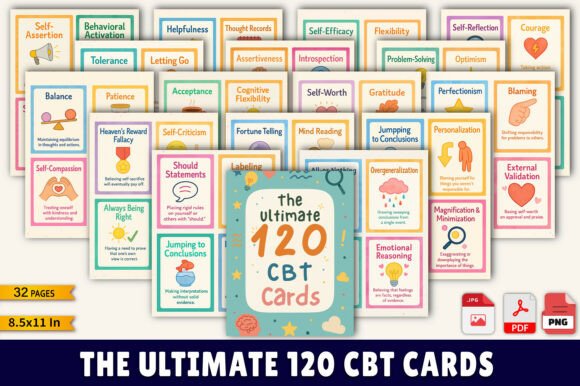
Unlike linear workbooks or dense clinical manuals, The Ultimate 120 CBT Cards organizes evidence-based concepts into discrete, self-contained prompts—each grounded in core CBT principles like cognitive restructuring, behavioral activation, and mindful awareness. The set spans 30 printable pages (8.5 x 11 inches), with four cards per page, totaling 120 distinct prompts grouped thematically: cognitive distortions, emotional labeling, boundary-setting scripts, self-compassion reframes, problem-solving scaffolds, and impulse regulation cues.
What makes this format distinctive isn’t just quantity—it’s intentionality in design. Each card avoids jargon, uses plain language, and includes space for brief written response or verbal reflection. There’s no required sequence; users can start with “Identify the distortion in this thought” one day and “Name three small actions that align with my values” the next. That flexibility supports both spontaneous use and structured practice—whether you’re journaling solo, guiding a coaching session, or facilitating a classroom discussion on emotional literacy.
How It Compares to Common Alternatives
When evaluating CBT tools, people often weigh options across several dimensions: depth vs. accessibility, structure vs. adaptability, and physical vs. digital delivery. The Ultimate 120 CBT Cards occupies a specific niche in that landscape.
Compared to CBT apps: Digital tools offer reminders, progress tracking, and voice-guided exercises—but they require device access, consistent data input, and sustained attention. In contrast, these cards require no login, battery, or subscription. They’re equally effective whether used on a kitchen table, in a therapist’s waiting room, or during a quiet moment before bed. However, they don’t provide analytics or adaptive feedback—so users seeking measurable habit change over time may want to pair them with simple manual tracking.
Compared to traditional workbooks: Most CBT workbooks follow a fixed progression—chapter one introduces thoughts, chapter two explores feelings, and so on. While helpful for systematic learners, that linearity can feel rigid when motivation dips or needs shift. The Ultimate 120 CBT Cards sidesteps that by enabling non-linear exploration. You might pull five cards focused on assertiveness after a difficult conversation, then switch to grounding prompts the next morning. That responsiveness suits people whose challenges fluctuate daily.
Compared to free online printables: Many free CBT handouts exist—but they’re often fragmented, inconsistently sourced, or lack clinical coherence. These cards were curated to reflect consensus practices taught in accredited training programs, with attention to developmental appropriateness and cultural neutrality. The inclusion of boundary-setting and self-compassion prompts—often underrepresented in entry-level materials—adds practical relevance for adults managing relationships, caregiving roles, or workplace dynamics.
Realistic Use Cases and Fit Considerations
This resource works best when integrated—not isolated. For example:
- A teacher might select three cards on emotional vocabulary to open a weekly social-emotional learning circle, inviting students to share examples from their own lives.
- A coach working with clients on imposter syndrome could assign a “challenge the evidence” card as homework, followed by discussion of how assumptions held up under scrutiny.
- An individual recovering from burnout might keep a small stack by their desk—drawing one card each morning to anchor attention before checking email.
It’s especially valuable for those who benefit from visual or kinesthetic learning—shuffling, sorting, or physically selecting a card creates subtle engagement that passive reading doesn’t replicate. That tactile element also supports memory retention: studies suggest that interacting with physical materials strengthens neural encoding more than screen-based equivalents for some learners.
Limitations and When to Look Elsewhere
Like any tool, The Ultimate 120 CBT Cards has boundaries. It does not replace clinical assessment or therapy for moderate-to-severe anxiety, depression, trauma, or other diagnosable conditions. The prompts assume baseline literacy and executive function—so they may be less accessible for individuals with significant cognitive load, untreated ADHD, or acute distress without additional support.
If your goal is deep skill-building in one area—say, mastering dialectical behavior therapy (DBT) distress tolerance—you’ll likely need more specialized, scaffolded instruction than these cards provide. Similarly, if you prefer audio guidance, real-time feedback, or integration with wearable biometrics, a digital platform may better match your learning style—even if it sacrifices some of the immediacy and simplicity these cards deliver.
Also worth noting: while the PDF is high-resolution and printer-friendly, the resource assumes access to basic printing capability. Users relying solely on mobile devices may find the 8.5 x 11 layout less convenient for on-the-go use unless they annotate digitally—a limitation shared by most printable therapeutic tools.
Practical Integration Tips
To get meaningful value from The Ultimate 120 CBT Cards, consider how you’ll engage—not just acquire. Start small: choose one theme (e.g., “reframing thoughts”) and explore five cards over a week. Jot down what resonates—and what feels vague or irrelevant. That reflection itself is part of the CBT process: noticing patterns, testing assumptions, adjusting based on experience.
Therapists and educators can extend utility by pairing cards with existing frameworks—using them alongside motivational interviewing, solution-focused questions, or narrative therapy prompts. Individuals using them independently may benefit from pairing card practice with a simple tracking method: a checkmark beside each prompt tried, plus one sentence on what shifted—or didn’t.
Because the cards are delivered as instant-download PDF, PNG, and JPG files, users can adapt format to context: print full sets for group facilitation, display single cards on tablets during telehealth sessions, or crop and paste prompts into digital journals.
Making an Informed Choice
Choosing a CBT resource isn’t about finding the “best” option—it’s about matching tool design to your current capacity, goals, and environment. The Ultimate 120 CBT Cards excels where simplicity, portability, and thematic breadth matter most. It’s a bridge between abstract theory and lived practice—not a replacement for deeper support when needed.
If you’ve tried apps that felt overwhelming, workbooks that gathered dust, or free printables that lacked cohesion, this set offers a refreshingly grounded alternative. It won’t solve everything—but it gives you 120 thoughtful, clinically informed starting points. And sometimes, that’s exactly what builds momentum: not perfection, but permission to begin—again and again—with curiosity instead of judgment.