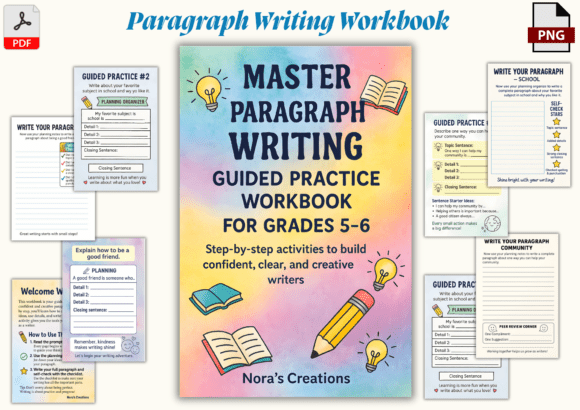
Paragraph Writing Workbook: A Practical Tool for Structured Writing Development
For educators, curriculum designers, homeschooling parents, and literacy coaches, the Paragraph Writing Workbook isn’t just another printable—it’s a precision-crafted component in a larger writing development workflow. Developed by Nora’s Creations, this 16-page PDF resource is designed to slot seamlessly into existing instructional routines, whether used as a standalone reinforcement tool, a scaffolded bridge between sentence-level work and full essay composition, or a targeted intervention for students who grasp ideas but struggle to organize them cohesively.
Where It Fits in the Writing Process
Writing instruction rarely happens in isolation. It’s embedded in lesson planning, formative assessment cycles, differentiation strategies, and student self-monitoring systems. The Paragraph Writing Workbook functions most effectively when positioned at the “structured practice” phase—after foundational concepts (like topic sentences or supporting details) have been introduced, but before students are expected to apply those skills independently across longer-form assignments.
In classroom settings, it often serves as a mid-week anchor activity: Monday introduces paragraph structure via modeling; Tuesday and Wednesday involve collaborative drafting and revision; Thursday uses the workbook for guided independent practice with immediate visual feedback (via self-check stars and peer review corners); Friday wraps up with reflection and the certificate of achievement as a tangible milestone. For homeschoolers, it becomes part of a weekly literacy block—paired with reading comprehension or vocabulary work—not as filler, but as deliberate skill consolidation.
Integration With Existing Tools and Methods
The workbook doesn’t require overhauling your current toolkit. It complements widely used frameworks like the Writing Workshop model, aligning cleanly with mini-lessons and independent writing time. Its transition word exercises reinforce grammar instruction from programs like Words Their Way or Grammar Explorer. Its reflection pages support metacognitive practices emphasized in SEL curricula and growth mindset initiatives.
It also interfaces well with digital platforms. Educators using Google Classroom can upload the PDF as an editable assignment (using tools like Kami or Adobe Acrobat), allowing students to type responses directly into lined spaces or annotate peer review sections. Homeschooling families often print select pages for offline use while keeping the full PDF on a tablet for quick reference during writing conferences.
Crucially, it avoids redundancy. Unlike broad writing rubrics or generic graphic organizers, the Paragraph Writing Workbook delivers specificity: each prompt ties to real-world contexts (friendship, school life, community involvement, imaginative storytelling), and each skill builder targets one discrete element—e.g., choosing *because*, *however*, or *in addition* based on logical relationship—not abstract definitions.
Practical Implementation Tips for Real Workflows
Preparation matters—but it’s minimal. No laminating, cutting, or prep sheets required. At 6 x 9 inches, it’s sized for standard binders and student desks. The lined spaces accommodate varied handwriting sizes without crowding, and the color-coded sections (not overly saturated) support focus without visual fatigue. For large classes, printing double-sided saves paper; for individualized pacing, teachers often assign only 2–3 pages per week, rotating prompts to match current thematic units (e.g., using the “community” section during a civics unit).
Usability hinges on its intentional constraints. With only 16 pages, it resists scope creep. There’s no pressure to “finish” it all at once. Instead, users treat it like a set of calibrated drills—revisiting pages as needed. A student who stumbles on concluding sentences can return to that specific skill builder without sifting through unrelated content. That focused design improves consistency: because expectations are clear and repeated, students internalize patterns faster than with scattered worksheets.
Quality control is built in—not added on. The self-check stars prompt immediate verification (“Does my paragraph have a topic sentence? ✅”). Peer review corners include simple, actionable prompts (“Find one strong detail—underline it”) rather than vague feedback requests. And the reflection pages ask concrete questions (“What part felt easiest? What part took the most thinking?”), turning subjective effort into observable data for both student and instructor.
Long-Term Use and Adaptability
This isn’t a “one-and-done” resource. Because it’s PDF-based, it scales across contexts: a tutor reuses it with multiple students over semesters; a small publisher bundles it into a summer learning kit; a freelance educator licenses it for inclusion in a paid course on academic writing foundations. Its clean layout ensures readability even after repeated printing, and its PNG version supports easy integration into custom slide decks or interactive whiteboard lessons.
More importantly, it grows with the user. While designed for Grades 5–6, its scaffolding makes it useful for older students needing remediation—and its emphasis on clarity and intentionality resonates with adult learners building professional communication skills. The same principles that help a 10-year-old craft a cohesive paragraph about their neighborhood park also underpin how a marketer structures a client email or how a blogger organizes a how-to post.
Workflow Examples Across Roles
- Classroom Teacher: Uses the “imagination” prompts during a creative writing unit, then cross-references student paragraphs with the district’s narrative writing rubric—identifying gaps in sequencing or sensory detail that inform next week’s mini-lesson.
- Homeschool Parent: Assigns one page per writing session, pairing it with a short mentor text (e.g., a paragraph from Wonder or a news article). After drafting, parent and child complete the reflection together, noting progress over time in a simple log.
- Curriculum Developer: Extracts the transition word framework to adapt into a school-wide grammar scope and sequence, using the workbook’s progression—from identifying transitions to selecting appropriate ones—to calibrate grade-level expectations.
- Friendly Freelancer or Content Coach: Recommends it to clients launching blogs or newsletters, framing paragraph discipline as foundational to reader retention—not as “schoolwork,” but as audience-centered communication hygiene.
Efficiency here isn’t about speed—it’s about reducing cognitive load so students and instructors alike can focus energy where it counts: on thinking, revising, and expressing ideas with confidence. The Paragraph Writing Workbook removes ambiguity about *what* to practice and *how* to know it’s working—freeing up mental bandwidth for deeper engagement with content and voice.
Ultimately, its value lies not in novelty, but in fidelity to process: clear entry points, consistent feedback loops, and measurable movement from guided support toward independence. That’s why it endures in lesson plans, resource libraries, and digital carts—not as a trend, but as a quietly effective node in the larger ecosystem of skilled writing development.