My Worry Monster Workbook: A Practical Tool for Helping Kids Name, Navigate, and Release Anxiety
If you’ve ever watched a child freeze before a school presentation, insist on checking the locks three times before bed, or whisper “what if” questions long after lights-out—you know worry doesn’t always look like tears or tantrums. It shows up in stomachaches before math class, in resistance to new routines, in clinginess during transitions. That’s where My Worry Monster Workbook steps in—not as a clinical fix, but as a gentle, hands-on companion for kids learning how anxiety feels in their bodies and minds.
This isn’t another workbook filled with abstract definitions or adult-led instructions. My Worry Monster Workbook meets children where they are: in imagination, play, drawing, storytelling, and small daily rituals. It’s designed for real life—not just therapy sessions or classroom lessons—but also quiet mornings at home, calm-down corners in preschools, telehealth follow-ups, or even travel bags for families managing big changes.
Where It Fits Naturally—Not Just “When You Have Time”
Think about your week: a teacher juggling 24 students and five minutes between classes; a parent trying to help their 7-year-old sleep through the night without reassurance loops; a therapist needing a tangible take-home tool that sticks beyond the session; a homeschooler building social-emotional learning into morning routines. My Worry Monster Workbook works *in those moments*—not instead of them.
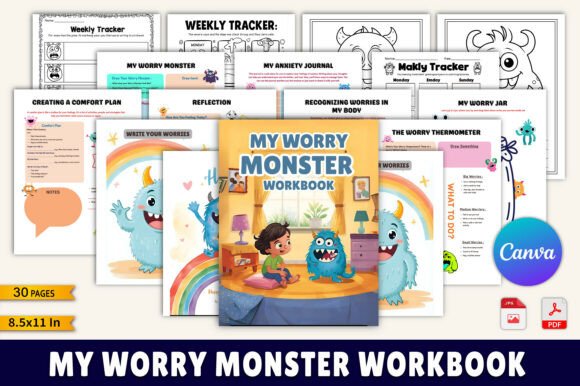
For educators, it’s a low-prep, high-impact resource. One third-grade teacher uses the Worry Thermometer every Monday during circle time—kids color in how “hot” their worries feel (1 = cool and calm, 10 = boiling over), then name one thing that helps bring it down. No lecture needed. Just noticing, naming, and practicing regulation together. Another special education aide prints individual pages for students who benefit from visual structure—and keeps the Comfort Plan page laminated on a clipboard for quick reference during transitions.
For caregivers, it’s less about “fixing” and more about co-regulating. When your child says, “I’m scared the dog will bark again,” instead of jumping to logic (“He’s friendly!”), you might open the workbook to the Draw Your Worry Monster page. As they sketch claws, too-big teeth, or a fuzzy tail, something shifts: the vague fear becomes external, nameable, even silly. That act alone reduces amygdala activation—it’s neuroscience wrapped in crayons.
How Different Users Get Real Value—Without Extra Work
A freelance illustrator downloaded My Worry Monster Workbook not to use with kids—but to adapt its framework for her own anxiety. She swapped monster drawings for client feedback monsters, turned the Worry Jar into a “client email vault,” and used the Positive Self-Talk prompts to reframe imposter syndrome. The structure gave her permission to pause, externalize pressure, and respond—not react.
A small publishing startup bought the editable Canva link to white-label the workbook for a wellness brand launching a kids’ mental health subscription box. They kept the core exercises intact but updated colors, added branded affirmations, and embedded QR codes linking to guided breathing audio. Because the templates are fully customizable (30 versions, all 8.5×11 and print-ready), they scaled production without hiring a designer.
Meanwhile, a pediatric occupational therapist uses the Anxiety Journal section alongside sensory tools. She’ll ask a child to draw how worry feels in their hands (tight? shaky?), then pair that with squeezing a stress ball or tracing a calming pattern. The journal isn’t about perfect sentences—it’s about anchoring emotion to physical experience, which builds interoceptive awareness—the foundation of self-regulation.
What to Consider Before You Use It
My Worry Monster Workbook works best when treated as a flexible toolkit—not a checklist. If your child resists writing, skip the Write Release page for now and start with coloring the monster or decorating the Worry Jar. If attention spans are short, use just one page per day—even the Daily Reflections check-in takes under two minutes.
Also consider access: the PDF files are high-resolution and printer-friendly, but if you’re working with schools or clinics, make sure your device supports editable Canva links (no download or install needed—just click and customize). And while the themes are universal, observe whether your child connects with “monster” language—if “cloud,” “storm,” or “robot” resonates more, encourage that shift. The goal isn’t fidelity to the metaphor—it’s fidelity to the child’s experience.
It’s also worth noting: this isn’t a replacement for professional support when anxiety is persistent, impairing, or tied to trauma. But it *is* a bridge—something concrete to hold onto while waiting for services, during maintenance phases of care, or as part of prevention-focused parenting or teaching.
Why the Details Matter—And How They Translate to Calmer Days
The Worry Thermometer isn’t just a scale—it teaches kids that worry exists on a spectrum, and that intensity can change. That awareness alone reduces panic: “This feels like a 7… but last time it was a 9, and I got through it.”
The Comfort Plan moves support from abstract (“Ask for help”) to actionable (“Go to the blue beanbag, hug my stuffy, listen to ocean sounds on Mom’s phone”). For neurodivergent kids especially, specificity = safety.
Even the page size—8.5×11 inches—is intentional. Big enough for motor-skill development, small enough to tuck into a backpack or therapy tote. And because every template is editable in Canva, you’re not stuck with one version: need larger fonts for visual processing? Add symbols for AAC users? Swap “monster” for “worry bug” in a kindergarten setting? Done—in minutes.
At its core, My Worry Monster Workbook helps adults stop asking, “How do I make this worry go away?” and start asking, “How can we understand it better—together?” That shift—from suppression to curiosity—changes everything. Not overnight. Not perfectly. But page by page, drawing by drawing, breath by breath.