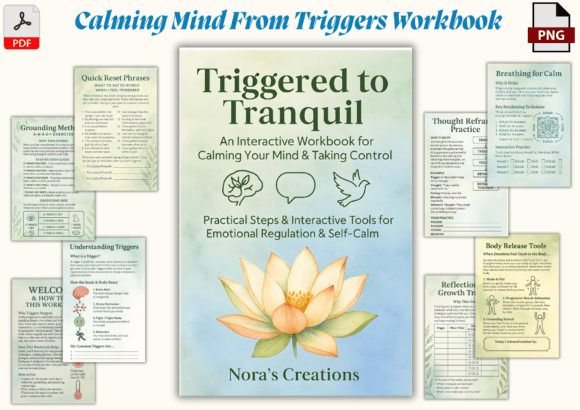
Calming Mind from Triggers Workbook: A Strategic Tool for Grounded Decision-Making
When your nervous system hijacks your focus mid-deadline, when a client email spikes your heart rate before you’ve even opened it, or when creative block feels less like resistance and more like emotional static—what do you reach for? Not another app notification. Not another breathing GIF scrolled past in haste. You need something tactile, intentional, and grounded in evidence—not inspiration. That’s where Calming Mind from Triggers Workbook becomes more than self-help. It becomes operational infrastructure for professionals who lead with clarity, not reactivity.
Why This Isn’t Just Another “Calm Down” Checklist
Most emotional regulation tools fail not because they’re ineffective—but because they’re disconnected from real-world workflow. They assume calm is a state to be achieved *after* the pressure lifts. Calming Mind from Triggers Workbook operates on a different premise: calm is a skill to be practiced *within* pressure. Its 30-page design isn’t about volume—it’s about precision. Each page serves a functional role in interrupting escalation cycles before they derail planning, communication, or execution.
Take the 5-4-3-2-1 sensory grounding exercise. It’s not listed as a “nice-to-have.” It’s positioned as a tactical reset—usable in 60 seconds between Zoom calls, before sending a sensitive message, or while waiting for feedback on a high-stakes proposal. Likewise, the box breathing guide paired with mandala flow isn’t decorative. The visual rhythm supports neurobiological regulation: inhale (trace one arc), hold (pause at the center), exhale (follow the next curve). This bridges physiology and attention—critical when your calendar demands sustained cognitive load.
Strategic Use Cases Across Professional Roles
How you apply Calming Mind from Triggers Workbook depends less on your title and more on your decision density—the frequency and consequence of choices you make under emotional load.
- Entrepreneurs & small business owners: Use the Emergency Plan template *before* crisis hits—not during. Map three likely triggers (e.g., cash flow dip, team conflict, platform algorithm change) and pre-write your first two response actions. This reduces decision fatigue when stakes are high.
- Creators, marketers, and publishers: Leverage the Thought Reframe practice after receiving critical feedback. Instead of editing reflexively, pause. Use the CBT-style flow to separate observation (“The headline didn’t convert”) from interpretation (“I’m bad at messaging”). That distinction protects long-term creative confidence.
- Educators and facilitators: Adapt the Body Release tools into micro-movement resets for virtual classrooms or workshops. A 90-second seated shoulder roll + breath cue (from the workbook’s breathing guides) signals safety to participants—and recalibrates your own presence before facilitating tough conversations.
- Freelancers and consultants: Anchor your Daily Reflection Growth Tracker to project milestones—not just completion dates. Note not only *what* shipped, but *how* you navigated friction: Did you use a Reset Phrase before renegotiating scope? Did the Personalized Calm Phrase collection shorten your recovery time after scope creep?
Intentional Integration, Not Passive Consumption
This workbook works only when treated as a working document—not a passive read. Its value compounds when embedded into existing systems:
- Pair it with your planning rhythm. If you block time weekly for strategy review, reserve the last 10 minutes for the Daily Reflection Growth Tracker. Ask: *Where did my nervous system override my intent this week—and what tool from the workbook could have shortened that gap?*
- Use the Certificate of Progress as a calibration point—not celebration bait. Print it after completing three full cycles of the Emergency Plan template with real scenarios. That’s not “finishing”—it’s evidence your threat-response patterns are shifting.
- Customize the Personalized Calm Phrase collection with outcome language. Instead of “I am safe,” try “I can pause before replying.” Instead of “I am enough,” try “I choose depth over speed in this decision.” Phrases tied to behavior—not identity—support agency.
Risks of Unstructured Use
Without intention, even research-backed tools become noise. Three common missteps erode the strategic value of Calming Mind from Triggers Workbook:
- Treating grounding as delay, not data. Using the 5-4-3-2-1 exercise to avoid a difficult conversation doesn’t build resilience—it reinforces avoidance. The goal isn’t to suppress the trigger; it’s to create space to *choose* your response. Ask: *What action becomes possible now that wasn’t 90 seconds ago?*
- Isolating tools from context. Breathing guides work best when aligned with physiological timing. Box breathing before a presentation leverages parasympathetic activation. Using it *during* an argument may disconnect you from relational cues. Match the tool to the phase of the stress cycle—not just the feeling.
- Confusing completion with competence. Filling every page of the workbook doesn’t mean you’ve internalized the practices. True integration shows in reduced latency between trigger and regulated response—and in your ability to teach the core principle (e.g., sensory anchoring) to a colleague without referencing the book.
Long-Term Positioning: From Reaction to Design
The most experienced professionals don’t eliminate triggers—they redesign their relationship to them. Calming Mind from Triggers Workbook supports that shift by making implicit processes explicit. When you log patterns in the Daily Reflection Growth Tracker across months, you begin seeing not just *what* triggered you—but *why* certain contexts (e.g., asynchronous communication, ambiguous deadlines, unspoken expectations) consistently activate your threat response.
That insight informs higher-leverage decisions: restructuring client onboarding to reduce ambiguity, building buffer time into project plans to absorb emotional labor, or choosing collaboration tools that support synchronous nuance over fragmented text. In other words, the workbook becomes diagnostic—not just therapeutic.
Practical Next Steps for Intentional Use
You don’t need to “start from page one.” Begin where friction lives:
- If email responsiveness drains your energy, open to the Reset Phrases section. Circle three that land physically—not just intellectually. Write them on a sticky note beside your keyboard. Test them for 48 hours. Notice if response time shifts—or if the quality of replies improves.
- If meetings leave you mentally exhausted, try the Body Release tools *before* your next call—not after. Do the seated neck rolls and jaw release while your camera is off. Track whether your ability to hold a complex idea improves.
- If planning feels overwhelming, use the Emergency Plan template to map one recurring stressor (e.g., “I forget key points in client calls”). Define your first physical action (stand up, take three breaths), your first verbal action (“Let me pause and clarify”), and your first follow-up (email summary within 1 hour). Then test it.
Calming Mind from Triggers Workbook earns its place not by promising peace—but by delivering precision. It meets professionals where they operate: in constraint, consequence, and complexity. Its watercolor visuals aren’t merely soothing—they signal psychological safety *on the page*, inviting engagement without demanding perfection. When used strategically, it transforms emotional regulation from a personal coping tactic into a quiet competitive advantage: the capacity to decide well, even when your body says otherwise.