100 Calming Strategy Cards for Kids: A Practical Framework for Emotional Regulation in Everyday Settings
Children experience emotions with intensity and immediacy—joy bursts into laughter, frustration escalates into tears or tantrums, and anxiety may show up as restlessness, withdrawal, or physical complaints like stomachaches. Unlike adults, they often lack the neurological maturity and practiced tools to pause, name, and modulate those feelings. This developmental reality makes structured yet flexible emotional support not just helpful—it’s essential. The 100 Calming Strategy Cards for Kids respond directly to that need, offering a research-informed, classroom-tested, and home-ready system grounded in developmental psychology, mindfulness science, and trauma-informed practice.
How Calming Strategies Align With Brain Development
The prefrontal cortex—the brain region responsible for executive function, impulse control, and emotional regulation—doesn’t fully mature until the mid-20s. In young children, especially under stress, the amygdala (the brain’s threat detector) can dominate response patterns. Calming strategies work by activating the parasympathetic nervous system—the “rest-and-digest” counterbalance to the “fight-or-flight” response. Techniques like paced breathing, grounding through sensory input, or gentle movement lower physiological arousal, making space for cognitive engagement and self-awareness to return.
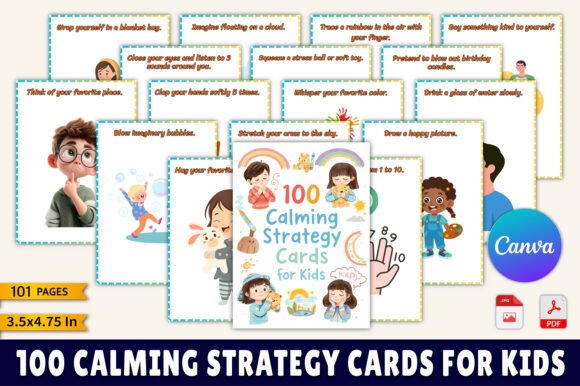
What distinguishes the 100 Calming Strategy Cards for Kids is their intentional design for this neurobiological reality. Each card avoids abstract language or lengthy instructions. Instead, prompts are action-oriented, concrete, and kinesthetic: “Trace your finger along an imaginary rainbow,” “Blow pretend bubbles—slow and steady,” or “Press your palms together like a butterfly closing its wings.” These aren’t just activities; they’re neurologically accessible entry points that bypass verbal overload and meet children where their bodies already are.
Real-World Implementation Across Diverse Environments
One of the most valuable attributes of the 100 Calming Strategy Cards for Kids is their adaptability—not as a one-size-fits-all solution, but as a responsive toolkit calibrated to context, time, and individual need.
In the Classroom
Teachers face competing demands: curriculum pacing, behavioral expectations, and inclusive instruction. A five-minute transition between math and literacy can become a moment of collective dysregulation—or a shared reset. Cards like “Five-Finger Breathing” (inhale while tracing thumb, exhale tracing index, and so on) require no materials and take less than 60 seconds. Others, such as “Draw Your Feeling Then Let It Float Away,” integrate art and emotional literacy seamlessly. Educators report using the cards during morning meetings, before high-stakes assessments, or as part of a calm-down corner—paired with visual cue cards and predictable routines.
In Therapeutic Practice
Clinicians working with children—including play therapists, occupational therapists, and school counselors—use the 100 Calming Strategy Cards for Kids to scaffold co-regulation. Rather than instructing a child to “calm down,” which can feel invalidating or confusing, a therapist might say, “Let’s try the ‘Tree Pose’ card together—feel your feet rooted, arms reaching like branches.” This shifts focus from compliance to collaboration. The editable Canva link allows clinicians to customize language for specific diagnoses (e.g., simplifying vocabulary for children with language delays or adding sensory accommodations for autistic learners), reinforcing evidence-based personalization.
At Home
Parents often seek strategies that don’t require prep time, special equipment, or expert training—and that respect the emotional labor already involved in caregiving. The 100 Calming Strategy Cards for Kids succeed here because many prompts are embedded in daily life: “Name three things you hear right now,” “Squeeze your shoulders like a turtle pulling into its shell,” or “Hum your favorite song slowly.” These require no printing, no apps, and no screen time—just presence and intention. Families also use the smaller 3.5×4.75 inch format as portable emotion toolkits—in backpacks, car consoles, or bedtime drawers—making regulation portable and normalized, not stigmatized.
Design Principles That Support Equity and Accessibility
Effective emotional tools must be usable across differences in language, ability, culture, and learning style. The 100 Calming Strategy Cards for Kids reflect this through deliberate design choices:
- Visual clarity: Icons accompany each prompt (e.g., a breath icon for breathing exercises, a sun for warmth visualization), supporting children who are pre-literate, bilingual, or neurodivergent.
- Movement integration: Over 40% of the cards include gentle physical actions—stretching, tapping, swaying—which align with embodied cognition research showing that body-based input enhances emotional processing.
- Low-barrier entry: No cards require expensive supplies. When materials are suggested (e.g., “blow real bubbles”), alternatives are implied (“pretend bubbles” works just as well).
- Cultural responsiveness: Prompts avoid assumptions about family structure, religious practice, or domestic environment—focusing instead on universal sensations (warmth, weight, rhythm, sound) and imaginative frameworks that children across backgrounds recognize and adapt.
Why “Playful” Isn’t Synonymous With “Superficial”
Some educators and caregivers hesitate to introduce playful techniques when facing serious emotional challenges—believing that rigor or seriousness signals importance. Yet decades of developmental science affirm that play is children’s primary mode of learning, processing, and mastery. When a child pretends to be a butterfly unfolding its wings, they’re not avoiding emotion—they’re embodying transformation, agency, and gentle emergence. When they trace a rainbow, they’re practicing sustained attention, bilateral coordination, and symbolic thinking—all foundational for emotional regulation.
The 100 Calming Strategy Cards for Kids honor this truth by treating play not as decoration, but as pedagogy. Each imaginative prompt serves dual functions: it engages the child’s natural curiosity and sense of wonder while simultaneously training neural pathways associated with self-soothing. This is why strategies like “Build a Calm Fort” or “Be a Worry Vacuum” resonate deeply—they meet emotional needs through the language children already speak fluently.
Integration Into Broader Well-Being Systems
No single resource operates in isolation. The 100 Calming Strategy Cards for Kids gain power when woven into larger frameworks:
- School-wide SEL initiatives: Cards align with CASEL’s core competencies—especially self-management and self-awareness—and can be mapped to grade-level benchmarks without curriculum overhaul.
- IEP and 504 accommodations: Specific cards can be written into behavior intervention plans as proactive, non-punitive supports—for example, “Use ‘Heavy Blanket Hug’ card before transitions” for a student with sensory processing differences.
- Family engagement efforts: Schools distribute printed sets or share editable templates, inviting caregivers to co-create calming rituals—strengthening home-school alignment and reducing caregiver burnout.
- Professional development: The cards serve as discussion anchors in staff workshops on de-escalation, trauma-informed practices, or mindful teaching—prompting reflection on adult regulation as a prerequisite for supporting children.
Observations From Practitioners Using the Cards
Across hundreds of documented uses—from rural preschools to urban middle schools, from private therapy offices to foster care agencies—consistent patterns emerge:
Children begin requesting specific cards by name within two weeks of consistent exposure. One third-grade teacher noted, “My student who used to bolt from circle time now asks for the ‘Cloud Watcher’ card—he lies on his back and watches ceiling tiles like clouds. It’s become his signal that he’s safe enough to stay.”
Adults report reduced reliance on reactive interventions. A school counselor observed, “When we introduced the cards during morning check-ins, office referrals for emotional escalation dropped 38% over one semester—not because big feelings disappeared, but because kids had more ways to navigate them before they peaked.”
Most significantly, the cards shift adult mindset. Instead of asking, “How do I stop this behavior?” educators and caregivers begin asking, “What does this child need right now to feel regulated?” That subtle pivot—from control to connection—is where sustainable emotional growth begins.
Practical Considerations for Sustainable Use
To maximize impact, practitioners recommend these evidence-informed practices:
- Introduce gradually: Start with 5–7 cards aligned to common classroom or home triggers (e.g., transitions, waiting, frustration). Mastery precedes expansion.
- Model authentically: Adults using the cards alongside children (“I’m feeling rushed—I’m going to try the ‘Hot Chocolate Breath’”) normalize regulation as a lifelong skill, not a childhood deficit.
- Anchor to routine: Pair cards with existing structures—e.g., “Before snack, we’ll do one breathing card,” or “After recess, choose a movement card to settle.” Predictability builds neural familiarity.
- Observe and iterate: Track which cards resonate most with specific children or groups. A child drawn to tactile prompts may thrive with “Squeeze a Stress Ball” variants, while another may prefer auditory ones like “Listen for Three Sounds.”
The 100 Calming Strategy Cards for Kids are more than a product—they’re a pedagogical invitation. They invite adults to slow down, notice, and respond rather than react. They invite children to trust their capacity to influence their inner world. And they invite systems—classrooms, clinics, homes—to prioritize emotional infrastructure with the same intentionality they apply to academic or physical safety. In a world increasingly demanding resilience, focus, and compassion, these cards offer not quick fixes, but quiet, consistent, and deeply human pathways forward.