1000 Kids Game Names: Endless Play, Zero Planning
Imagine having every game idea you’ll ever need—sorted, printable, and ready to use—without scouring ten different websites, rewriting rules from memory, or second-guessing age appropriateness. That’s what 1000 Kids Game Names delivers: a thoughtfully curated, practical collection of play ideas spanning indoor quiet time, chaotic backyard energy, classroom learning moments, birthday party flow, Diwali or Easter celebrations, and open-ended creative exploration.
This isn’t a list of vague prompts like “play tag” or “do a puzzle.” Each entry in 1000 Kids Game Names is a distinct, actionable concept—complete with implied structure, typical age range, core skill focus (e.g., turn-taking, spatial reasoning, phonemic awareness), and natural grouping cues (e.g., “requires chalk,” “works with 3+ players,” “no prep needed”). It’s designed not as entertainment trivia, but as working infrastructure for adults who design, facilitate, or support children’s development.
Why Teachers Reach for This Resource Mid-School Year
A third-grade teacher preparing for a rainy-day rotation knows that “indoor recess” can’t mean five rounds of the same board game. With 1000 Kids Game Names, she scans the “Quiet Focus” and “Movement Break” sections side by side—finding “Shadow Alphabet Relay” (kinesthetic letter recognition) alongside “Story Stone Chain” (collaborative narrative building). She prints two pages, laminates them, and has two fresh 15-minute stations ready in under four minutes.
The value isn’t just volume—it’s curation logic. Games are grouped by function *and* environment, so filtering feels intuitive, not algorithmic. No need to deduce whether “Balloon Keep-Up” belongs indoors (yes, if ceiling height allows) or outdoors (better for larger groups). The resource flags those nuances contextually.
How KDP Publishers Build Better Activity Books—Faster
For creators developing printable journals or themed activity bundles (e.g., “Summer Camp Planner,” “Homeschool Movement & Learning Kit”), sourcing original, non-duplicated game names is time-intensive—and legally delicate. Copying rules from blogs risks copyright issues; inventing 100 unique variations per theme drains creative bandwidth.
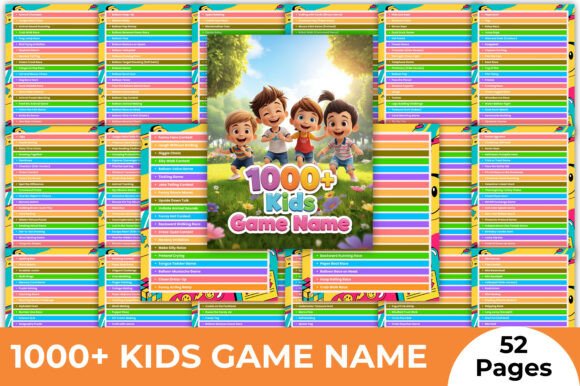
1000 Kids Game Names solves both. Its 52-page interior includes clean, consistent naming conventions (“Musical Emotion Freeze,” “Fraction Hopscotch,” “Festival Lantern Riddle Walk”) that inspire themed expansions—not just copy-paste reuse. The editable Canva link lets publishers adjust fonts, colors, or layout while preserving readability at 8.5 × 11″. And because all formats (PDF, PNG, JPG) are 300 dpi print-ready, there’s no last-minute panic over blurry thumbnails or cropped margins on KDP preview.
One homeschool curriculum designer told us she used 67 entries from 1000 Kids Game Names to populate her “Learning Through Play” journal series—adding only brief facilitation tips and reflection prompts. That cut her content creation time by nearly 40%, without sacrificing educational intentionality.
Parents and Camp Organizers: Less Guesswork, More Presence
When your child asks, “What do we do now?” after screen time ends—or when 12 kids arrive at a neighborhood picnic—you don’t need inspiration. You need reliability. 1000 Kids Game Names works offline: print a single page titled “Backyard Classics + Twists,” keep it in a binder, and rotate through “Reverse Red Light Green Light,” “Bubble Counting Race,” and “Nature Bingo Scavenger Hunt” across three weekends. No app required. No Wi-Fi dependency.
Camp directors appreciate how easily the collection scales. The “Large Group Coordination” section includes games designed for 15–30 children with minimal equipment—like “Human Knot Relay” or “Silent Line-Up Challenge”—while “Small Group Calm-Down” offers options for post-lunch transitions. It’s not about filling time; it’s about matching energy, attention span, and social capacity moment-to-moment.
A Note on Fit and Realistic Use
1000 Kids Game Names is most powerful when treated as a springboard—not a script. It doesn’t include full rulebooks, safety guidelines, or material lists for every game. That’s intentional: those details depend heavily on your setting (classroom square footage, park surface type, group size), and over-specifying would reduce flexibility.
If you need step-by-step video demos or adaptive modifications for neurodiverse learners, this resource complements—but doesn’t replace—specialized training or inclusive play frameworks. Likewise, educators using Reggio Emilia or Montessori approaches will still want to align each game with their pedagogical values. But having 1000 vetted starting points means less time searching, more time observing, adapting, and responding.
What You Actually Get—No Surprises
The download delivers exactly what’s described:
- 52 pages of cleanly formatted, printer-friendly content—no watermarks, ads, or upsell banners.
- All 1000 Kids Game Names listed individually, with clear section headers (e.g., “Festival & Cultural Games,” “STEM-Themed Movement,” “Cooperative Puzzles”).
- Multiple file types: PDF (for immediate printing), high-res PNG/JPG (for digital planners or social media graphics), and an editable Canva link (to customize fonts, add logos, or resize for A4 or spiral-bound notebooks).
- No subscriptions, no logins—just download, use, adapt.
It’s built for people who respect their own time. Whether you’re drafting a 30-page KDP journal this weekend, prepping for Monday’s lesson plan, or planning your nephew’s birthday party next month—1000 Kids Game Names removes friction, not fun.
Who Benefits Most—And Why It Sticks
The strongest return comes to those juggling multiple roles: a parent who also teaches Sunday school, a freelance designer building activity kits, or a small-business owner running a nature-based preschool. For them, 1000 Kids Game Names functions like a shared vocabulary—bridging home, classroom, and commercial creation. It reduces cognitive load across contexts, so energy goes into delivery, not discovery.
That consistency matters. When a child plays “Shape Shadow Match” at school, then sees the same name (with slight variation) in their summer journal at home, continuity reinforces confidence and engagement. The resource supports coherence—not just convenience.
In short: 1000 Kids Game Names won’t replace your judgment, your relationship with the children you serve, or your ability to improvise. But it does remove one persistent bottleneck—running out of fresh, appropriate, ready-to-go ideas—so you can invest more where it counts.