Mindful Motherhood Coloring Book
The Mindful Motherhood Coloring Book isn’t a passive activity—it’s a deliberate pause built into the rhythm of daily life. Designed for mothers who juggle roles as caregivers, professionals, creators, and individuals, it functions as both anchor and catalyst: a tactile tool that supports emotional regulation, intentional reflection, and creative reconnection—without demanding hours of time or complex setup. At its core, it bridges two high-impact practices—mindful colouring and structured journaling—into a single, portable 6x9 inch format that fits seamlessly into existing routines, not alongside them.
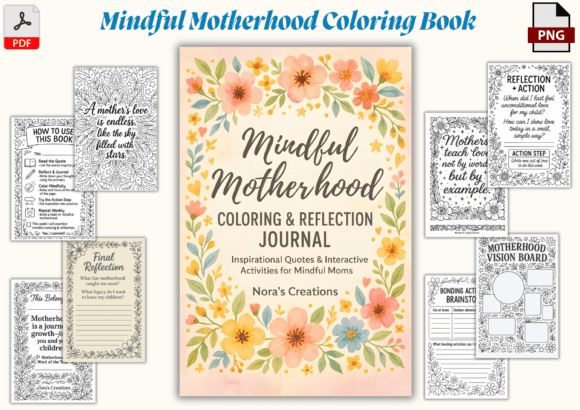
For professionals managing calendars packed with meetings, educators preparing lesson plans before dawn, freelancers balancing client deadlines with family needs, or entrepreneurs iterating on product launches while parenting small children, mental bandwidth is finite. The Mindful Motherhood Coloring Book works *with* that constraint—not against it. Its 32-page structure is intentionally lean: no filler, no redundant prompts, no vague instructions. Each page serves a functional role—colouring design, reflective question, gratitude tracker, affirmation, or vision board space—and each is sized and spaced for clarity when printed at home or viewed on a tablet.
Integration begins before the first stroke of colour. Because the resource ships as both PDF and PNG files, users can choose their workflow path: print a single page to use during morning coffee, load the full PDF into a note-taking app like Notion or GoodNotes for digital annotation, or extract individual PNGs for custom layouts in Canva or Adobe Express. This flexibility means the Mindful Motherhood Coloring Book doesn’t replace existing tools—it layers into them. A marketing manager might paste a “Patience Practice” prompt into her weekly planning template. A homeschooling parent could pair a floral colouring page with a child’s art session, using the same design as a shared focus exercise. A therapist supporting postpartum clients might assign one reflection prompt per session, tracking themes across weeks without needing proprietary software.
Preparation is minimal but meaningful. Unlike journals requiring pens, stickers, or multiple notebooks, this system asks only for colouring tools (markers, pencils, or even finger paint for tactile variety) and five to fifteen focused minutes. That low barrier supports consistency—especially important when building habits around self-awareness or emotional resilience. Research shows that brief, repeated mindful engagement yields stronger neural adaptation than infrequent, lengthy sessions. The Mindful Motherhood Coloring Book leverages that principle: its guided prompts are concise, its designs balanced between detail and openness, and its pacing calibrated to sustain attention without overwhelm.
Usability extends beyond layout. The prompts avoid prescriptive language (“You should feel…” or “Every mother must…”), opting instead for open-ended, process-oriented questions: “What small choice today reminded you of your strength?” or “Where did you notice resistance—and what happened when you softened around it?” These invite honest response, not performance. Similarly, the gratitude and patience trackers aren’t checkboxes—they’re visual cues paired with space for brief notes, reinforcing observation over obligation. That design choice supports long-term use: when users return after days or weeks away, they don’t face guilt-inducing blank pages—they find accessible entry points.
Compatibility with other resources is built-in. The certificates and vision board templates work alongside goal-setting frameworks like OKRs or SMART objectives—imagine printing the “My Calm Anchor” certificate and taping it beside a workspace monitor, or sketching a child’s drawing onto the vision board page next to a career milestone. Affirmations are phrased for repetition aloud or internalization—not just reading—making them functional in voice-note reviews or breathwork pauses. Even the decorative borders serve purpose: their repetitive patterns support grounding during anxious moments, functioning like portable fidget tools for adults who need sensory input without distraction.
Efficiency gains emerge in how the book reduces decision fatigue. Instead of scrolling for “self-care ideas” or debating whether to meditate, journal, or stretch, users open to a known, trusted page. That predictability builds reliability—critical when consistency matters more than intensity. A small business owner launching a new service might use the “Boundaries Check-In” prompt every Sunday evening, aligning her capacity with upcoming client commitments. A blogger drafting a vulnerable personal essay could colour the “Voice & Truth” page before writing, using the physical act to quiet inner critics. In each case, the Mindful Motherhood Coloring Book acts as a ritual scaffold—not replacing deep work, but preparing the mind to enter it with greater presence.
Quality control is embedded in structure. With only 32 pages, there’s no room for redundancy or weak prompts. Every quote is sourced for resonance, not virality; every tracker designed for insight, not decoration. Nora’s Creations avoids trend-chasing aesthetics—the line work is clean, the spacing generous, the typography legible at 100% zoom or 200% print size. That attention ensures usability across devices, age ranges, and ability levels. Parents with dyslexia or ADHD report appreciating the visual hierarchy; those recovering from burnout highlight the absence of “shoulds” in the language. These aren’t accidental features—they’re outcomes of intentional design aligned with real-world constraints.
Long-term integration depends on adaptability—and this book delivers. It’s not meant to be completed cover-to-cover and shelved. Instead, users cycle through pages based on need: returning to the “Reconnection Ritual” prompt after a conflict, re-colouring the “Growth Spiral” design when facing a new challenge, or revisiting past journal entries to spot patterns in patience or energy shifts. Some keep a dedicated notebook for responses; others use sticky notes to layer reflections directly onto printed pages, creating evolving collages. One educator laminated her favourite pages and uses dry-erase markers—reusing prompts weekly with different answers. That kind of reuse isn’t an exception—it’s baked into the format.
For teams or communities, the Mindful Motherhood Coloring Book scales quietly. A parenting group might assign one prompt per week for shared discussion. A corporate wellness program could include select pages in onboarding kits for working parents. Bloggers and content creators use the PNG files as visual anchors in newsletters or social posts—pairing a finished colouring page with a short reflection on boundary-setting or creative replenishment. Because it’s ready-to-print and copyright-cleared for personal and small-group use, it moves fluidly between private practice and collaborative application.
Ultimately, the Mindful Motherhood Coloring Book succeeds where many self-care tools fail: it meets mothers where they are—not as idealized versions of themselves, but as humans navigating complexity with limited margins. It doesn’t ask for more time. It asks for attention—focused, gentle, and returned regularly. And in doing so, it becomes less of a “product” and more of a practice: one that strengthens self-trust, clarifies values, and quietly reshapes how care flows—from self to child, from home to work, from moment to meaning.