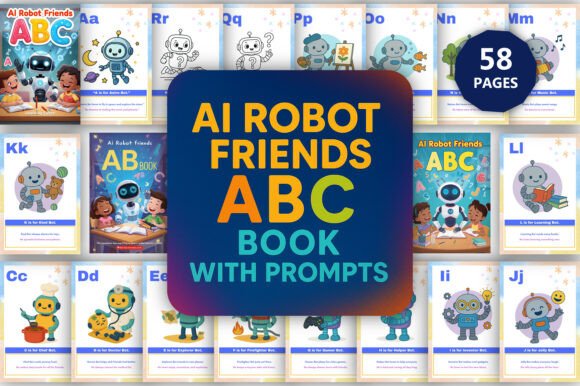
AI Robot Friends ABC Book with Prompts
Imagine a resource that doesn’t just teach the alphabet—but invites children to invent stories, solve puzzles, and express emotions—all while tracing “A” with Astro Bot or matching “Z” with Zippy Bot. The AI Robot Friends ABC Book with Prompts does exactly that: it transforms foundational literacy into a multidimensional learning experience grounded in play, identity, and creative agency.
More Than Flashcards—A Scaffold for Early Cognitive Growth
For educators designing lesson plans or parents supporting early learners at home, consistency matters—but so does novelty. This book meets both needs. Each letter introduces a robot friend tied to a meaningful concept: Doctor Bot models care and empathy, Teacher Bot reinforces guidance and curiosity, and Unicorn Bot opens space for imaginative abstraction. These aren’t decorative characters—they’re cognitive anchors. Research shows that associating letters with relatable roles (e.g., “C is for Chef Bot who cooks with care”) strengthens memory encoding far more than isolated phonics drills.
The built-in prompts go beyond “What sound does B make?” They ask, “What would Builder Bot build for your family?” or “Draw what Explorer Bot sees on Mars—and label three things.” That subtle shift—from recall to application—supports language development, narrative reasoning, and fine motor integration. Tracing practice isn’t rote; it’s contextualized within each robot’s world (e.g., tracing “R” along rocket fins). Coloring pages double as visual discrimination exercises—spotting gear shapes, circuit patterns, or seasonal symbols builds observation skills without labeling them as “work.”
Real-World Utility Across Learning Environments
Homeschooling families often juggle curriculum design, material prep, and engagement fatigue. The AI Robot Friends ABC Book with Prompts reduces planning overhead by bundling literacy, art, logic, and social-emotional learning into one physical or printable resource. A single page might include: a rhyme (“D is for Doctor Bot—she checks your heart and gives you hugs”), a tracing guide, a “spot two differences between Day Bot and Night Bot” puzzle, and a blank speech bubble for kids to write or dictate what Doctor Bot says during a checkup.
In classrooms, teachers use the seasonal robots—Eid Bot with lanterns, Diwali Bot with diyas, Halloween Bot with a friendly jack-o’-lantern—as low-pressure entry points for cultural sharing. These aren’t token additions; they’re integrated into letter practice (e.g., “L is for Lantern Bot lighting up the night”). For therapists or special educators, the emotion bots—Calm Bot, Brave Bot, Joy Bot—offer concrete vocabulary for naming feelings, paired with drawing prompts like “Color Brave Bot’s shield blue if you feel strong today.”
Creativity as Literacy Infrastructure
Many early-learning tools treat creativity as an “extra”—a coloring sheet after the real work is done. This book treats it as infrastructure. The bonus creative bots—Art Bot, Music Bot, Storytelling Bot—are not gimmicks. Art Bot includes texture rubbings and shape-mixing challenges. Music Bot introduces rhythm through clapping patterns tied to letter sounds (“T-tap-tap-tap!”). Storytelling Bot provides story-starters (“One day, Zoom Bot forgot his rocket fuel…”) with space to draw or dictate the next scene.
This approach aligns with how young brains learn best: through multimodal input. When a child draws Chef Bot’s kitchen while sounding out “K,” they’re reinforcing orthography, phonology, and semantics simultaneously. It’s efficient—not because it’s faster, but because it’s deeper.
Who Benefits Most—and When It Fits Best
The AI Robot Friends ABC Book with Prompts shines for adults supporting children ages 3–8, especially those prioritizing holistic development over narrow skill acquisition. Educators using play-based or Reggio-inspired approaches find it complementary—not prescriptive. Freelance curriculum designers reference its prompt structures when building custom units. Small publishers appreciate its ready-to-adapt seasonal and thematic extensions (e.g., adapting Eid Bot for interfaith storytelling workshops).
That said, it’s not a standalone solution for every context. Families seeking intensive phonics intervention may need supplemental decodable readers. Classrooms requiring strict alignment to specific state standards should cross-check scope and sequence—but many find its flexibility allows easy layering onto existing frameworks. Its strength lies in enrichment, not replacement.
Time-Saving Without Sacrificing Depth
Here’s where practical value becomes tangible: no printing 12 separate activity sheets for one letter. No hunting for culturally responsive images or emotion visuals. Everything lives in one cohesive system—with intentional white space for notes, doodles, or extension ideas. A teacher can assign “Explorer Bot’s Map Maze” as morning work, then use the same page’s “Write one thing Explorer Bot discovered” prompt for journaling. A parent can spend 15 focused minutes—tracing, coloring, and chatting—without switching apps, devices, or mental gears.
And because the robots are open-ended (no fixed backstories), kids—and the adults guiding them—retain full authorship. There’s no “right answer” to what Unicorn Bot dreams about. That freedom lowers pressure and raises engagement, especially for hesitant writers or neurodivergent learners who thrive with choice-driven tasks.
A Resource That Grows With Its Users
What makes this more than a flash-in-the-pan trend is its scalability. A 3-year-old traces “A” with a finger while naming Astro Bot’s stars. A 6-year-old writes a four-sentence story about Teacher Bot’s classroom. An 8-year-old invents their own robot—“Ninja Bot”—and designs a “N”-shaped shuriken to trace. The extra notes pages aren’t afterthoughts; they’re invitations to iterate, reflect, and claim ownership of learning.
For creators and small business owners developing educational products, this book offers a case study in thoughtful design: how themed characters can carry pedagogical weight, how prompts can scaffold rather than direct, and how inclusivity isn’t added—it’s embedded in the architecture (e.g., robots with varied body types, mobility devices, and cultural markers appearing organically across letters).
Ultimately, the AI Robot Friends ABC Book with Prompts works because it respects children as thinkers, storytellers, and world-builders—not just future test-takers. It meets adults where they are: time-constrained, intention-rich, and deeply invested in raising capable, curious humans. And in doing so, it turns the alphabet from a list into a launchpad.