2026 Gratitude with Prompts Journal: A Thoughtful Framework for Intentional Living
Gratitude is more than a fleeting feeling—it’s a cognitive habit, a relational practice, and a well-documented catalyst for psychological resilience. As we approach 2026, many individuals are seeking tools that support sustained emotional regulation, deeper self-awareness, and grounded presence—not just during moments of calm, but amid complexity, transition, and uncertainty. The 2026 Gratitude with Prompts Journal emerges not as another generic planner, but as a deliberately structured invitation to slow down, reflect meaningfully, and reorient attention toward what already exists with value in daily life.
Why Structured Reflection Matters More Than Ever
In an era defined by fragmented attention, algorithmic feeds, and reactive communication, unstructured journaling often stalls after a few entries. Without scaffolding, people default to surface-level observations (“I’m grateful for coffee”) or abandon the practice entirely when motivation wanes. Research from the Greater Good Science Center at UC Berkeley shows that gratitude practices yield measurable benefits—improved sleep, reduced inflammation markers, increased empathy—only when they’re consistent and personally resonant. That’s where the 2026 Gratitude with Prompts Journal distinguishes itself: it embeds evidence-informed structure into accessible design.
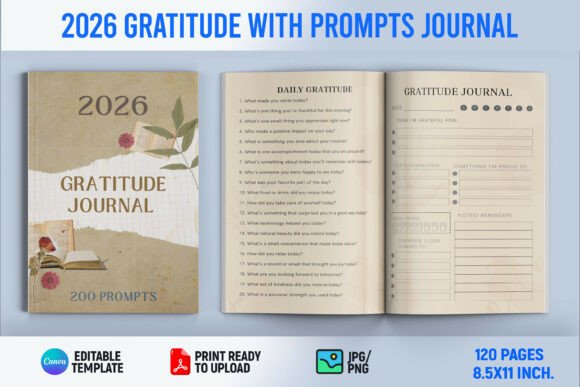
The 200 curated prompts avoid repetition while progressing intentionally across themes—interpersonal connection, embodied awareness, small joys, growth through challenge, quiet competence, and future-oriented hope. One prompt might ask, “What did someone do today that made you feel seen—without them knowing?” Another invites reflection on a skill you’ve quietly strengthened over time. These aren’t abstract affirmations; they’re observational anchors that train attention toward nuance, agency, and relational texture.
Designed for Real Life, Not Idealized Routines
This isn’t a journal that assumes you’ll write every morning at 5:30 a.m. with chamomile tea and ambient lighting. Its 120-page layout accommodates variability: some days may hold three thoughtful responses; others, one sentence and a sketch in the margin. The inclusion of “This Book Belongs To” on the first page establishes personal ownership—not obligation. It signals that this tool belongs to you, not to productivity culture.
The physical and digital flexibility further supports real-world use. The PDF file is optimized for home printing on standard letter or A4 paper, with bleed-safe margins and crisp typography. For those who prefer digital annotation, the Canva Editable File allows customization—changing fonts, adjusting spacing, inserting personal photos or quotes, or adapting prompts for specific contexts like team check-ins or classroom reflection. Educators have repurposed pages for student-led gratitude circles; therapists integrate select prompts into goal-setting sessions; small business owners adapt them for team appreciation rituals. Each use case retains the journal’s core integrity: gentle guidance, not prescriptive rigidity.
More Than a Personal Tool: A Catalyst for Shared Meaning
While often framed as a solitary activity, gratitude is inherently relational—and so is this journal’s utility. Consider how the 2026 Gratitude with Prompts Journal Canva Template functions beyond individual reflection:
- Gift-giving with intention: Unlike mass-produced notebooks, this journal carries built-in warmth—a personalized cover option via Canva, space for handwritten notes on the inside front cover, and prompts that invite vulnerability without pressure. It’s a gift that says, “I see your capacity for depth, and I want to support it.”
- Digital product creation: Creators building online courses, coaching programs, or wellness subscriptions use the editable Canva file to brand prompts within their ecosystem—adding logos, custom color palettes, or companion worksheets—while preserving pedagogical soundness.
- Community facilitation: Faith groups, recovery circles, and neighborhood associations print select prompts as discussion starters. Because each prompt avoids assumptions about belief systems or life stage, they foster inclusive dialogue—e.g., “What’s something you repaired recently—object, relationship, or expectation?”
These applications underscore a subtle but critical distinction: this journal doesn’t ask users to “fix” themselves. Instead, it offers language and rhythm for noticing what’s already working—even in constrained circumstances.
How the Design Reinforces Psychological Safety
Visual design isn’t aesthetic garnish here—it’s functional scaffolding. Soft, warm color palettes (in the Canva template) reduce cognitive load. Ample white space prevents overwhelm. The absence of rigid date fields means skipping days doesn’t register as failure. Even the choice of serif body font improves readability during low-energy moments—critical for sustaining practice across seasons.
Importantly, the journal avoids toxic positivity. No prompt demands forced cheerfulness. Several explicitly honor complexity: “What’s one thing you’re carrying gently right now—and what helps you hold it?” Others invite acknowledgment of effort over outcome: “When did you choose rest instead of pushing? What signaled that need?” This balance—between uplift and honesty—is what makes the 2026 Gratitude with Prompts Journal durable across life phases: postpartum exhaustion, career pivots, caregiving strain, or creative drought.
Practical Integration Across Roles and Routines
Different users engage with the journal in ways aligned with their rhythms—not prescribed ideals:
- Professionals: Use the first five minutes before checking email to respond to one prompt. Over time, patterns emerge—e.g., recurring appreciation for collaborative problem-solving signals alignment with team-based work environments.
- Educators: Print single-page prompts for Friday reflections. Students respond anonymously; themes inform lesson planning—e.g., repeated mentions of “feeling heard” lead to revising participation structures.
- Researchers: Treat entries as qualitative data about subjective wellbeing. Code recurring themes across weeks—not to measure “success,” but to map shifts in attentional focus and narrative framing.
- Hobbyists: Pair journaling with tactile practice—sketch beside a prompt about texture, stitch a phrase onto fabric, or compose a haiku in response to a nature-themed question.
- Business owners: Adapt prompts for customer feedback synthesis—e.g., “What’s one thing our service helped you protect or preserve?” yields richer insight than traditional satisfaction scores.
Each integration honors the user’s existing habits rather than demanding new ones—a key factor in long-term adoption.
What Makes This Distinct From Other Gratitude Tools?
Many journals offer prompts—but few calibrate them across cognitive, emotional, and behavioral dimensions. The 2026 Gratitude with Prompts Journal Canva Template integrates three rarely combined elements:
- Progressive sequencing: Early prompts build observational fluency (“Name three sounds you heard today that brought comfort”). Later ones deepen integration (“How has your definition of ‘enough’ shifted in the past year?”).
- Low-barrier entry points: Each prompt includes optional sentence stems (“I noticed…”, “It mattered because…”, “One way I’ll honor this tomorrow is…”), reducing the blank-page paralysis common in freeform writing.
- Cross-platform fidelity: Whether printed, annotated digitally, or adapted into slides for workshops, the core reflective function remains intact—no feature lock-in, no subscription dependency.
This combination supports what psychologists call “micro-practices”: brief, repeatable actions that accumulate neural reinforcement over time. You don’t need hours—just 90 seconds with one prompt—to activate circuits associated with reward processing and social cognition.
Building Consistency Without Compromise
Consistency isn’t about frequency—it’s about continuity of intention. The 2026 Gratitude with Prompts Journal supports this by removing friction at every touchpoint: the PDF prints cleanly on demand; the Canva file saves instantly; PNG versions allow quick sharing in messaging apps for accountability partners. There’s no login, no sync delay, no algorithm deciding which prompts you “should” see next.
Users report that the most transformative shift isn’t in mood—but in perception. After six weeks, many notice spontaneous gratitude arising unprompted: pausing mid-commute to appreciate sunlight on brickwork, sensing relief during a difficult conversation, or recognizing competence in a routine task previously taken for granted. That’s not magic. It’s neuroplasticity guided by intentional repetition—made possible by a tool designed for humanity, not perfection.
As 2026 unfolds, the value of such grounded presence will only increase. The 2026 Gratitude with Prompts Journal doesn’t promise transformation. It offers something quieter, more reliable: a steady hand holding space for what’s true, tender, and already here.