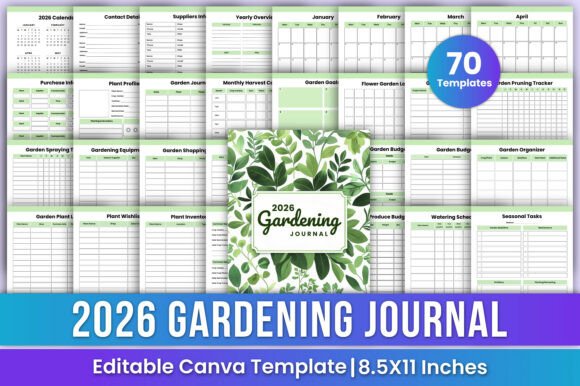
2026 Gardening Journal Bundle Canva
The 2026 Gardening Journal Bundle Canva is a digital collection of editable, printable garden planning templates designed for home gardeners who prefer structured, visual organization. It consists of high-resolution 8.5×11 inch PDF files optimized for use in Canva—meaning users can customize text, colors, fonts, and layout elements before printing or saving. Unlike physical journals or static PDFs, this bundle prioritizes flexibility: each page functions as a working document that adapts to individual gardening systems, plant varieties, climate zones, and personal tracking preferences.
This resource targets gardeners seeking consistency across seasons—not just notes, but integrated systems for recording planting dates, monitoring growth stages, managing inputs like water and fertilizer, logging expenses, and evaluating harvest yields. Its scope spans foundational tools (e.g., yearly calendar, contact list) through specialized trackers (e.g., pruning schedule, spraying log, equipment inventory), supporting both ornamental and edible gardening goals.
Who Might Benefit Most?
Gardeners who value intentional planning—and who already use or are comfortable learning Canva—may find the 2026 Gardening Journal Bundle Canva especially useful. It suits those who:
- Maintain multiple beds, containers, or growing areas and need spatial planning tools like editable flower garden layouts or garden layout vision boards;
- Track costs across seasons and want built-in budgeting, expense logs, and shopping lists;
- Grow from seed and require plant profile pages, seed logs, and germination date tracking;
- Prefer reviewing progress at multiple time scales—yearly goals, monthly tasks, weekly actions—and benefit from synchronized calendars and harvest timelines;
- Want to reduce administrative overhead by consolidating scattered notes into one consistent system.
Because all templates are editable in Canva, users retain control over structure. You can delete unused sections (e.g., pruning tracker for low-maintenance gardens), duplicate pages for parallel projects, or adjust column widths to accommodate detailed observations. This adaptability supports evolving practices—whether transitioning from beginner container gardening to multi-season crop rotation or adding pollinator habitat planning.
Practical Benefits and Realistic Considerations
One clear advantage is time efficiency: rather than building spreadsheets or sketching layouts from scratch, users start with tested frameworks. The inclusion of plant care guides and seasonal to-do lists offers contextual support—not prescriptive advice, but prompts aligned with common horticultural rhythms. The garden project planner and cleaning checklist also help break larger goals into actionable steps, which supports consistency without requiring advanced technical skills.
However, effectiveness depends on user engagement. Like any planner, the 2026 Gardening Journal Bundle Canva does not automate data entry or generate insights—it organizes input so users can identify patterns themselves. There’s no integration with weather APIs, soil testing services, or smart irrigation systems. Users must manually record observations and interpret trends (e.g., correlating delayed flowering with late spring frosts).
Also, while Canva access is free, full editing capabilities—including font customization and certain layout adjustments—require a Canva Pro subscription for teams or individuals using brand kits or premium assets. Basic edits (text changes, color swaps, simple reordering) work in the free version, but complex layout modifications may be limited. Users should verify compatibility with their current Canva plan before purchase.
When Alternatives May Be More Suitable
This bundle is less ideal for gardeners who prioritize minimalism or rapid capture. If your workflow relies on voice memos, quick photo logging, or mobile-first note-taking, a dedicated app (e.g., Gardenate, GrowIt!, or even Notion-based setups) may offer faster input and better cross-device sync. Similarly, those needing regulatory compliance (e.g., commercial growers tracking pesticide applications for audits) may require certified digital recordkeeping tools with audit trails—not editable PDFs.
Physical journal users who enjoy tactile writing and resist screen-based planning may find the Canva dependency a barrier—even though final outputs are printable, the editing step occurs digitally. In such cases, a well-structured printed journal with pre-drawn grids and seasonal prompts could provide similar structure without software reliance.
Finally, gardeners focused exclusively on native or low-intervention ecosystems may find some trackers redundant. Sections like spraying logs or intensive pruning schedules assume active management; if your approach emphasizes observation over intervention, you may use only 30–40% of the bundle’s pages regularly.
Making an Informed Choice
Before choosing the 2026 Gardening Journal Bundle Canva, consider how you currently document garden activity. Do you keep handwritten notes in a notebook? Use spreadsheets? Rely on memory or fragmented apps? If your system lacks continuity—e.g., harvest data lives in one place, planting dates elsewhere, expenses in another—the bundle’s integrated design helps unify those streams.
Ask yourself whether you’re willing to spend 10–20 minutes weekly updating entries. Consistent use amplifies value: a single season’s worth of harvest logs reveals yield gaps; comparing monthly watering totals highlights irrigation inefficiencies; reviewing plant inventory across years informs succession planning. But sporadic use limits insight generation, regardless of template quality.
Also assess your comfort with digital tools. Canva has a gentle learning curve, but navigating layers, resizing text boxes, or exporting print-ready PDFs may feel unfamiliar at first. Reviewing Canva’s free tutorials ahead of time helps determine whether the setup effort aligns with your expectations.
Lastly, compare scope. Some competitors offer single-purpose templates (e.g., seed starting logs only), while others bundle broader lifestyle planning (e.g., meal prep + garden logs). The 2026 Gardening Journal Bundle Canva stands out for depth within its domain—not breadth across life categories—but that focus means fewer distractions and more relevant prompts per page.
Final Perspective
The 2026 Gardening Journal Bundle Canva is a practical tool for gardeners who seek clarity through structure and are comfortable shaping digital templates to match their real-world needs. It doesn’t replace knowledge or experience—it supports reflection, measurement, and iteration. Its strength lies not in automation, but in intentionality: guiding attention to what matters most across the growing year. Whether used cover-to-cover or selectively, it serves best when matched to a gardener’s willingness to engage consistently—not as a passive record, but as an active partner in planning, observing, and learning.