2026 Glow-Up Lifestyle Journal: A Practical Guide for Intentional Living
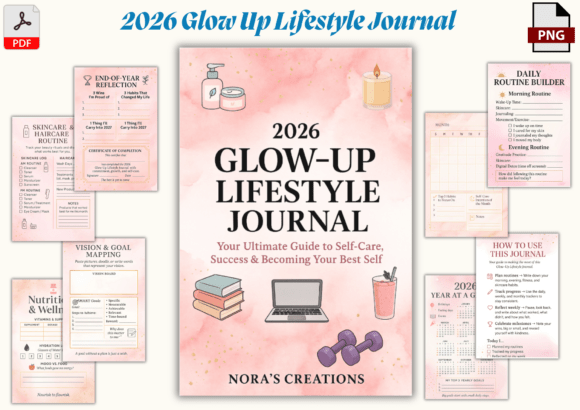
The 2026 Glow-Up Lifestyle Journal is a focused, 16-page interactive planner designed to support holistic personal development—not as a rigid productivity system, but as a flexible companion for people who want consistency without overwhelm. Unlike comprehensive year-long planners with daily logs or dense habit matrices, this journal prioritizes structure through intentionality: each page serves a distinct purpose, from mapping long-term vision to capturing small moments of joy or rest. Its 6x9-inch size strikes a balance between portability and usable writing space—large enough for thoughtful reflection, compact enough to keep on a nightstand or tuck into a work bag.
What Sets the 2026 Glow-Up Lifestyle Journal Apart
At its core, the 2026 Glow-Up Lifestyle Journal emphasizes integration over isolation. Many planning tools separate goal setting, wellness tracking, and emotional reflection into siloed sections—or omit one entirely. This journal intentionally bridges them. For example, the Vision Goal Mapping Template doesn’t just ask “What do you want?” It prompts users to align objectives with self-care capacity (“How will I protect energy while pursuing this?”) and gratitude anchors (“What’s already working that supports this goal?”). Similarly, the Self-Care Wellness Logs go beyond checklists—they include space to note how a practice felt, not just whether it happened.
The inclusion of a Travel Memory Log reflects a subtle but meaningful distinction: it treats lifestyle growth as experiential, not just behavioral. Rather than framing progress solely through metrics (steps taken, meals logged), it invites users to document sensory details, interactions, and shifts in perspective—recognizing that transformation often happens outside structured routines.
Its digital-native format—available as both PDF and PNG—also shapes how it functions. Because it’s not a physical bound book, users can print only the pages they need, reorder sections, or annotate digitally across devices. That flexibility suits people who rotate focus areas monthly (e.g., prioritizing fitness in Q1, then shifting to creative expression in Q2) or who prefer hybrid use (writing reflections by hand, logging nutrition in a notes app).
Comparing Approaches: When Structure Supports Growth—and When It Doesn’t
Planners fall along a spectrum from highly prescriptive to loosely thematic. The 2026 Glow-Up Lifestyle Journal sits near the middle: more guided than a blank journal, less exhaustive than a full-year dated planner. That positioning creates clear tradeoffs.
Strengths:
- Low entry barrier. With only 16 pages—and no requirement to fill every day—it avoids the guilt common with unused daily journals. Someone returning to self-reflection after months of burnout may find this easier to resume consistently.
- Cross-category alignment. Habit trackers sit alongside gratitude prompts, so users naturally see connections—e.g., noticing how consistent sleep correlates with more frequent moments of appreciation.
- Adaptable pacing. Because pages aren’t date-stamped, users can revisit the Reflection Reset Page mid-quarter or use the End-of-Year Certificate of Completion as a milestone marker—even if they start in March.
Limits to consider:
- It doesn’t replace systems requiring daily accountability—like medication reminders, detailed calorie counters, or project-based time blocking. Users needing those features would likely pair it with another tool rather than rely on it alone.
- There’s no built-in guidance on *how* to interpret patterns—e.g., what to do when nutrition logs show low energy despite “good” choices. It provides the container, not the interpretation framework.
- Because it’s undated, it offers less scaffolding for beginners who benefit from sequential cues (“Week 1: Build awareness. Week 2: Adjust one habit.”)
Fitting the 2026 Glow-Up Lifestyle Journal Into Real Life
Realistic use cases help clarify fit. Consider three examples:
- A freelance designer launching a new service line in 2026. She uses the Vision Goal Mapping Template to define her ideal client profile and revenue targets—but pairs it with the Gratitude Affirmation Prompts to counter imposter feelings that surface during outreach. She prints only the goal map and affirmation page for Q1, adding the Fitness Nutrition Tracker later when energy dips during long editing sessions.
- A teacher returning from parental leave. Her schedule is unpredictable, and rigid scheduling causes stress. She uses the Monthly Planner to block broad categories (“Admin,” “Lesson Prep,” “Rest”) instead of hourly slots—and fills the Self-Care Wellness Log weekly, not daily. The lack of daily pressure makes consistency possible.
- A recent retiree redefining purpose. He values reflection over output. He uses the Travel Memory Log for local walks, noting birds seen or conversations had, and the End-of-Year Certificate as a tangible milestone—something he can frame—not because he “achieved” predefined goals, but because he showed up for his curiosity.
In each case, the 2026 Glow-Up Lifestyle Journal works because it meets the user where they are—not by demanding uniformity, but by offering calibrated support.
Alternatives Worth Weighing
That said, it’s not universally optimal. Readers evaluating options should consider these decision factors:
- If your priority is habit formation with behavioral science backing, research-supported tools like habit stacking journals or apps with streak analytics may offer more scaffolding for repetition and reinforcement.
- If you need deep emotional processing, a dedicated therapy journal with CBT or DBT prompts might provide more clinical nuance than the Reflection Reset Pages, which prioritize accessibility over technique-specific depth.
- If you’re coordinating across multiple people (e.g., family routines or team goals), shared digital calendars or collaborative boards often integrate more seamlessly than a single-user PDF journal.
The 2026 Glow-Up Lifestyle Journal excels when the goal isn’t perfection or volume—but coherence. It helps users notice alignment (or misalignment) between actions and values, making it especially useful during transitions: career shifts, health changes, or life-stage adjustments where old systems no longer fit.
Making a Grounded Choice
Ultimately, the value of any planning tool depends less on its features and more on whether it sustains engagement over time. The 2026 Glow-Up Lifestyle Journal reduces friction by design: no setup required, no learning curve, no pressure to “catch up” if you skip a week. Its strength lies in gentle insistence—not on doing more, but on choosing what matters, noticing what’s present, and honoring growth that isn’t always visible on a chart.
For someone who’s tried elaborate systems and abandoned them, or who wants to begin cultivating intention without overcommitting, it offers a grounded starting point. For someone needing clinical support, granular data, or real-time collaboration, it’s better used as one element within a broader ecosystem—not the sole solution.
Like any well-designed tool, the 2026 Glow-Up Lifestyle Journal doesn’t promise transformation. It creates conditions where transformation becomes more likely: space to reflect, structure to connect ideas, and permission to celebrate progress—not just outcomes.