🔥 Little Minds Adventure Book
If you're looking for a creative, screen-free way to nurture imagination, emotional expression, and early literacy in children aged 4–8, the 🔥 Little Minds Adventure Book stands out—not as just another coloring book, but as a thoughtfully structured creative workbook. It’s designed for kids who light up at the idea of building robots, diving into coral reefs, mapping treasure islands, or inventing their own superpowers. But before you download, print, or assign it in your classroom—or even gift it to a curious young explorer—there are practical details many overlook. Getting those right makes all the difference in how deeply a child engages, how smoothly an adult can support them, and whether the experience delivers lasting value.
What It Really Is (and What It’s Not)
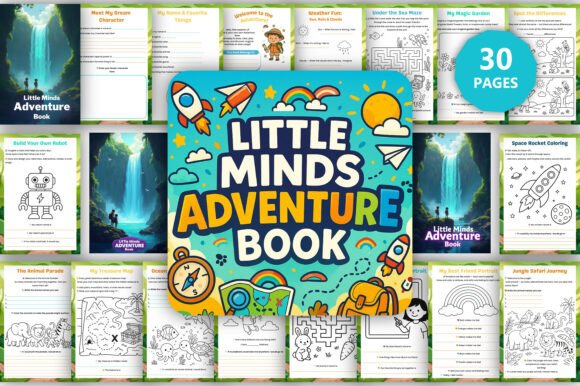
The 🔥 Little Minds Adventure Book is a 30-page interactive activity workbook—not a passive coloring book, nor a rigid curriculum. Each page invites participation: drawing your dream castle, navigating a maze mission, writing a short story about a friendly robot, or designing ocean creatures with made-up names and habitats. The prompts are open-ended by design, encouraging storytelling, problem-solving, and self-expression. That’s why educators use it during quiet time or morning centers, parents take it on road trips, and therapists incorporate it into social-emotional learning routines.
But here’s where confusion often starts: some assume it’s “just for fun” and skip reviewing the prompts ahead of time. Others expect step-by-step instructions—and get frustrated when a page says only, “Draw what happens next…” without showing an example. That’s intentional. The space is left open so children lead. Adults don’t need to “teach” each page—but they do benefit from previewing it first to understand the intent behind each activity.
A Common Mistake: Treating It Like a Worksheet Instead of a Launchpad
One frequent misstep? Using the 🔥 Little Minds Adventure Book like a checklist—“Let’s finish pages 1–5 before lunch.” When that happens, the playful spirit fades. Kids may rush, skip reflection, or disengage entirely. Worse, adults unintentionally narrow creativity by asking, “What’s the right answer?” instead of, “What would *you* add here?”
Try this instead: pick one page per day—even two or three times a week—and spend 10–15 minutes truly exploring it together. On “My Superpowers,” ask: “If your power helped someone today, who would it be—and how?” On “Fly with Balloons,” encourage describing wind, clouds, or what’s below—not just drawing shapes. That small shift transforms routine practice into meaningful connection.
Overlooking the Bonus Tools—and Why They Matter
The editable Canva link and high-quality PDF files aren’t extras—they’re functional advantages. Some users download the PDF, print it once, and stop there. But the Canva access lets you personalize pages: swap “castle” for “spaceship” for a space-obsessed child, adjust font size for emerging writers, or add bilingual labels for dual-language learners. That flexibility extends the book’s lifespan across age ranges, abilities, and learning goals.
Before printing, check your printer settings. “Fit to Page” can distort illustrations or shrink text too much—especially on mazes or writing lines. For best results, choose “Actual Size” and use standard 8.5" x 11" paper. If using digitally (on tablets with styluses), verify that layers are unlocked in the PDF so annotations work smoothly.
Misjudging Age Fit—And How to Adjust
While labeled for ages 4–8, the 🔥 Little Minds Adventure Book scales naturally—if used intentionally. A 4-year-old may dictate a story while you scribe; a 7-year-old might write independently and expand the prompt into a full paragraph. But if you hand the same unmodified page to both without scaffolding, engagement drops.
Better approach: use the themes as springboards. For younger kids, simplify language (“Tell me about your robot friend”) and offer physical supports (crayons over pencils, tracing guides). For older kids, layer challenges: “Add a problem your character solves,” or “Write three sentences using ‘because,’ ‘so,’ and ‘then.’” The content stays rich—you just meet the child where they are.
Skipping the Explorer Certificate—And Missing a Key Moment
The final “Explorer Certificate” isn’t filler. It’s a research-backed opportunity to reinforce effort, growth, and completion. Yet many print and set it aside—or forget it entirely. That missed moment weakens the sense of accomplishment and reduces motivation for future creative work.
Instead, treat it like a milestone ritual. Print it on cardstock, let your child color it, sign it together, and display it somewhere visible—even briefly. One kindergarten teacher laminates certificates and adds them to students’ “Learning Portfolios.” A parent frames hers beside artwork. Small, yes—but psychologically powerful.
What to Check Before You Commit
- File compatibility: Confirm your device opens PDFs with annotation tools (if using digitally) and that Canva access works with your account type (free accounts support editing).
- Print readiness: Look for bleed-safe margins and CMYK-ready colors if ordering professional prints—though home printers handle it well.
- Educational alignment: While not standards-aligned by label, many pages support early ELA (narrative structure, vocabulary), fine motor development (drawing, cutting), and SEL (identifying feelings, perspective-taking). Review with your goals in mind.
- Reusability: Since pages are open-ended—not fill-in-the-blank—you can revisit favorites months later with new ideas, making it more durable than single-use workbooks.
Ultimately, the 🔥 Little Minds Adventure Book shines brightest when treated as a collaborative tool—not a product to consume, but a shared language to explore. It doesn’t replace conversation, play, or real-world discovery. It invites those things in. And when used with intention—previewing pages, personalizing prompts, honoring process over perfection—it becomes more than an activity book. It becomes a quiet, joyful catalyst for confidence, curiosity, and creative courage.