The Little Ghost Who Couldn’t Boo
At first glance, The Little Ghost Who Couldn’t Boo reads like a gentle Halloween story—softly spooky, warmly illustrated, and built around Gus, a timid little ghost who just can’t muster the classic “BOO.” But look closer, and you’ll see something more: a quietly strategic children’s picture book designed for real-world resonance. It meets young readers where they are—ages 3 to 7—with emotional authenticity, not forced lessons. And it meets creators, educators, and small publishers where *they* are: in a market that increasingly rewards intentionality over volume, warmth over whimsy, and developmental awareness over trend-chasing.
A Story That Fits How Families Actually Read Today
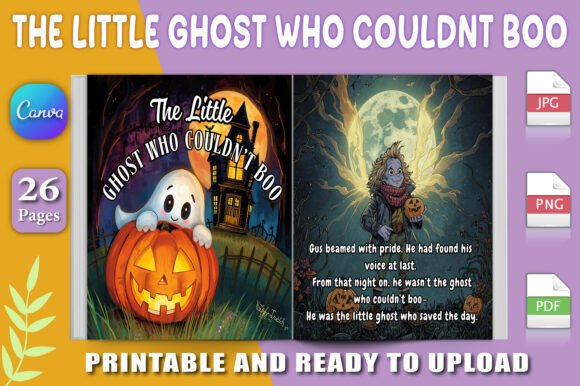
Modern bedtime reading isn’t about filling minutes—it’s about anchoring connection. Parents juggling work, screen time, and emotional labor don’t reach for books that shout; they reach for ones that settle. The Little Ghost Who Couldn’t Boo answers that need with its sweet, heartwarming tone and carefully paced rhythm. Its “spooky-but-safe” balance avoids sensory overload while still honoring seasonal excitement—a subtle but meaningful calibration many new picture books miss. The pumpkin jack-o’-lantern and haunted house icons aren’t just decorative; they’re visual anchors that help pre-readers anticipate narrative beats, supporting early literacy without instruction.
This aligns with observed shifts in family media habits: fewer passive screens, more intentional co-reading moments—even if only 12 minutes before lights out. A book like this doesn’t compete with tablets; it complements them by offering shared laughter (Gus’s failed “BOO” attempts are genuinely funny), quiet reflection (the candle lantern scene invites pause), and emotional scaffolding (his bravery isn’t loud or sudden—it builds gently, like real confidence does).
Why Bravery Isn’t Just a Theme—It’s a Practical Skill for Young Readers
Bravery, self-confidence, and finding your voice aren’t abstract concepts in early childhood—they’re daily negotiations. A child who won’t raise their hand, who hesitates at the edge of the slide, or who whispers instead of speaking up is practicing courage in real time. The Little Ghost Who Couldn’t Boo mirrors those micro-moments without moralizing. Gus doesn’t become fearless—he becomes *capable*. His turning point isn’t a roar; it’s a clear, resonant sound born from care, not conquest. That distinction matters.
Educators and therapists increasingly cite picture books like this as low-stakes tools for social-emotional learning (SEL). Unlike worksheets or scripted role-play, stories embed growth in context. When Gus saves the haunted house—not with strength, but with presence and timing—children absorb a nuanced truth: courage often looks like showing up, not standing out. The sparkle star icon isn’t just decoration; it’s a visual cue that ties bravery to identity, not performance.
KDP Publishing Meets Emotional Intelligence
For creators choosing between Amazon KDP and traditional publishing—or even between self-publishing options—the decision around The Little Ghost Who Couldn’t Boo reflects broader industry evolution. KDP no longer means “quick and generic.” It means agility, audience alignment, and control over both message and medium. This book’s product details—editable AI Canva files, 300 DPI JPG/PNG/PDF versions—aren’t just convenience features. They reflect how today’s creators work: iteratively, collaboratively, and across platforms.
Imagine an indie illustrator adapting the black cat scene for a bilingual edition, or a homeschool parent resizing the candle lantern illustration for a classroom poster—all without licensing hurdles or design delays. That flexibility responds directly to how small creative businesses operate now: lean, responsive, and user-centered. It also signals respect for the buyer’s autonomy—not just as a consumer, but as a co-creator of meaning.
Icons With Purpose—Not Just Polish
Every icon in The Little Ghost Who Couldn’t Boo serves a functional role beyond branding:
- 👻 Cute Ghost Icon: Reinforces character recognition across formats—critical for early readers building visual memory.
- 🎃 Pumpkin Jack-o’-lantern: Grounds the story in cultural familiarity while keeping spookiness accessible (no teeth, no shadows—just friendly glow).
- 🕯️ Candle Lantern: Represents the story’s emotional pivot—not just light in darkness, but inner clarity emerging through calm attention.
- 🐾 Cat Paw Icon: Anchors the supportive relationship dynamic (the black cat isn’t comic relief; it’s Gus’s quiet ally), modeling healthy interdependence.
- ⭐ Sparkle Star Icon: Visual shorthand for agency—Gus doesn’t “find” his voice like a lost object; he activates it, intentionally.
- 🏠 Haunted House Icon: Establishes setting as character—not threatening, but lived-in, communal, and worth protecting.
- 💖 Heart Icon: Signals emotional safety upfront, helping caregivers quickly assess fit for sensitive or anxious children.
These aren’t afterthoughts added for SEO or shelf appeal. They’re part of a cohesive design language—one that supports comprehension, emotional regulation, and re-readability. In a crowded children’s market, that kind of intentionality separates memorable books from forgettable ones.
What This Means for Creators, Educators, and Caregivers
If you’re developing content for young children—or selecting it—you’re likely weighing more than entertainment value. You’re asking: Does this support regulation? Does it honor neurodiversity? Does it leave room for questions, not just answers? The Little Ghost Who Couldn’t Boo succeeds because it assumes competence in its audience. Gus stumbles, recalibrates, and acts—not because he’s “fixed,” but because he’s trusted.
For educators, it’s a springboard for conversations about nervous systems (“What does your body feel like before you try something new?”) and voice (“What’s one way you’ve said something important—even quietly?”). For parents, it’s permission to name fear without urgency, to celebrate small sounds before big shouts. For creators, it’s proof that specificity—of emotion, of audience need, of visual storytelling—builds longevity far more reliably than broad appeal.
And for the growing number of professionals using children’s literature in coaching, therapy, or community work? This book offers a rare combination: clinical relevance wrapped in genuine charm. No jargon. No agenda. Just Gus, a candle, a cat, and the quiet, radiant moment when he finally says what needs saying—not because he’s fearless, but because he’s ready.
Looking Ahead—Without Overpromising
There’s no indication that emotional literacy in children’s publishing is a passing trend. If anything, demand is deepening—not for more books, but for better-aligned ones. Parents search for “books about shyness for preschoolers” or “Halloween stories without scares” with increasing precision. Algorithms reward relevance. Bookstores curate by values, not just genres. And children, especially post-pandemic, respond powerfully to narratives that acknowledge hesitation as valid—and growth as gradual.
The Little Ghost Who Couldn’t Boo doesn’t try to be everything. It doesn’t promise overnight transformation. It offers something quieter, and more durable: a mirror, a map, and a soft place to land—all inside 32 beautifully paced pages. That’s not just good storytelling. It’s thoughtful infrastructure for early emotional development.