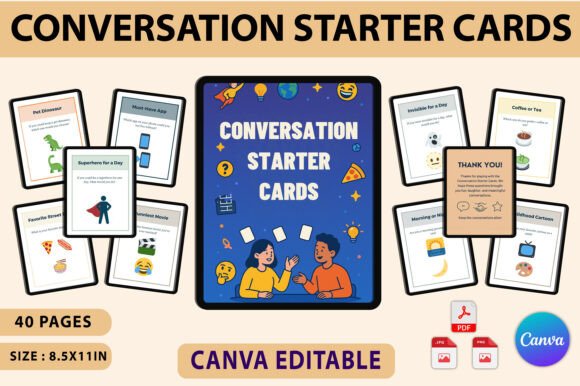
Conversation Starter Cards: Spark Real Connection
Ever sat in a room full of people—family at Thanksgiving, colleagues in a hybrid team meeting, students on the first day of class—and felt the silence stretch just a little too long? That’s not awkwardness. It’s untapped potential. Conversation Starter Cards meet that moment with quiet intention: 35 thoughtfully crafted prompts designed not just to fill silence, but to invite presence, curiosity, and shared humanity.
More Than Just “Icebreakers”
Most icebreakers ask surface-level questions (“What’s your favorite color?”) or force performative answers (“Tell us three fun facts!”). Conversation Starter Cards take a different approach. Each prompt balances accessibility with depth—like “What’s something small that made you smile this week?” or “If you could send one message back to your 16-year-old self, what would it be?” These aren’t conversation fillers. They’re gentle invitations to show up authentically—without pressure, without performance.
The visual icons reinforce that tone: a sun for warmth, a lightbulb for ideas, hands clasped for connection. You don’t need instructions to understand the intent. That simplicity saves time—especially when you’re facilitating a workshop, leading a parent-teacher night, or hosting a friend’s birthday dinner.
Where These Cards Create Measurable Value
For educators: In classrooms where engagement fluctuates and attention spans shrink, these cards offer low-prep, high-return discussion tools. A middle school teacher might use the “What’s a skill you taught yourself?” card to launch a unit on growth mindset—or pair it with journaling using the included note pages. No lesson planning required, just genuine student voice.
For remote and hybrid teams: Zoom fatigue isn’t solved by more slides—it’s eased by moments of shared humanity. One marketing manager uses a single card per weekly standup (e.g., “What’s one thing you’ve learned from a mistake recently?”). It takes under two minutes, builds psychological safety, and often surfaces insights that improve collaboration far more than status updates ever could.
For families and caregivers: With teens who default to “fine” and grandparents who hesitate to share memories unless prompted, these cards become subtle bridges. The question “What’s a tradition you’d love to start—or bring back?” has sparked multi-generational storytelling at three separate family dinners, according to one user. Not because it’s clever—but because it gives permission to reflect, not report.
Designed for Real Use, Not Shelf Life
The printable 8.5×11 format means no special equipment is needed—just a home printer and scissors (or a paper cutter for clean edges). But what makes them truly adaptable is the Canva-editable version. A freelance facilitator swaps out icons or adjusts wording to match her brand voice before printing branded decks for client workshops. A nonprofit educator adds local context—replacing “favorite season” with “a place in our neighborhood that feels like home”—to deepen relevance.
The 40 template variations aren’t about aesthetics alone. Some feature minimalist layouts for clarity in large-group settings; others include subtle background textures that reduce glare during screen sharing. And the dedicated note pages? They transform passive listening into active reflection—ideal for coaches guiding clients through values exploration or HR leads debriefing post-retreat feedback.
Who Benefits Most—and When to Pause
These cards serve people who value substance over speed: teachers building classroom culture, managers nurturing trust, content creators designing interactive workshops, therapists integrating narrative tools, and even solo users journaling through life transitions. If your goal is deeper listening—not just more talking—this tool aligns.
That said, they’re not a substitute for skilled facilitation in high-stakes or emotionally complex settings. A grief support group, for instance, would need trained guidance before introducing prompts like “What’s something you wish people understood about your experience?” Likewise, in highly regulated environments (e.g., legal or clinical intake), always review prompts for appropriateness. The strength of Conversation Starter Cards lies in their flexibility—not universality.
Why the Physical + Digital Combo Matters
Digital tools dominate, yet tactile interaction changes how we engage. Holding a card slows the pace. Flipping through the deck invites choice and agency—unlike scrolling through a list on screen. That physicality supports memory retention and emotional resonance, especially for neurodiverse participants or those relearning social confidence.
Yet the digital files ensure accessibility: adjust font size for low vision, translate prompts for bilingual groups, or embed cards directly into a slide deck. One university DEIB coordinator prints oversized versions for wall displays during orientation weeks—then shares the editable file with faculty so they can adapt prompts for discipline-specific discussions in labs or studios.
A Small Tool With Ripple Effects
You won’t find grand claims here about “transforming relationships overnight.” What you will find is consistency: the same card used across six months of team check-ins gradually shifts how people listen—to pause before responding, to ask follow-up questions, to remember names and details. That’s how trust compounds.
It’s also how creativity surfaces. A product designer shared how the prompt “What would this idea look like if it had no budget or timeline?” unlocked a breakthrough during a stalled sprint review—not because it was revolutionary, but because it temporarily removed habitual constraints.
At their core, Conversation Starter Cards honor a simple truth: meaningful connection doesn’t require perfection. It requires invitation, intention, and the right kind of nudge. Whether you’re preparing for a holiday dinner, onboarding new hires, or simply wanting to know your neighbor better—they help you begin where real conversations do: with curiosity, respect, and space to breathe.
Keep the conversations alive.