The Night Charlie Met a Dragon: A Thoughtful Look for Parents and Educators
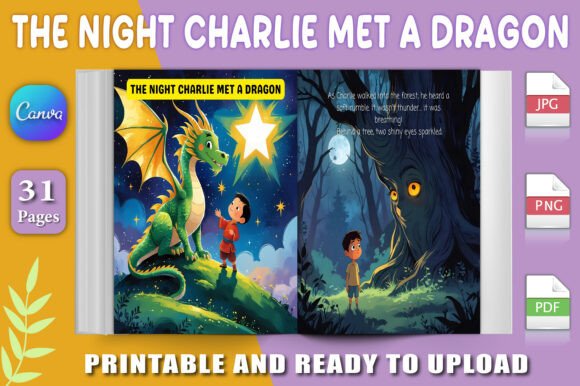
The Night Charlie Met a Dragon is a 31-page illustrated children’s bedtime story designed for readers ages 6–8. It tells the gentle, wonder-filled tale of young Charlie, who discovers a glowing light in the forest—and meets a kind, soft-spoken dragon waiting just for him. Their quiet adventure unfolds with warmth and curiosity, emphasizing friendship, quiet courage, and the idea that magic lives in stillness and openness. Unlike many fantasy stories aimed at early readers, this one avoids high-stakes conflict or fast-paced action. Instead, it leans into emotional resonance, calm pacing, and visual storytelling—making it especially suited for winding down before sleep or supporting social-emotional learning in low-pressure settings.
What Sets This Story Apart from Other Bedtime Books?
Most picture books for this age group fall into two broad categories: those built around rhythmic repetition and predictable patterns (ideal for emerging readers), and those centered on vivid, action-driven plots (often used to hold attention during lively story times). The Night Charlie Met a Dragon occupies a quieter middle ground. Its narrative rhythm is lyrical but not rhyming; its illustrations are rich and intentional, yet uncluttered—leaving space for imagination rather than over-explaining. The dragon isn’t a problem to solve or a challenge to overcome. It’s a companion—curious, patient, and grounded in kindness. That subtle shift makes the book stand out in a crowded market of animal- and fantasy-themed stories.
The physical format also reflects thoughtful design choices. At 8.5 x 8.5 inches, it fits comfortably in small hands and aligns with standard printing dimensions—no cropping or scaling needed. The print-ready PDF ensures consistent color fidelity and crisp text across home printers or professional print shops. For educators or parents who regularly produce classroom materials or personalized storybooks, that reliability matters.
How Does the Editable Canva Template Fit Into Real-World Use?
The included editable Canva template adds practical flexibility—not as a replacement for the finished book, but as a tool for adaptation. You can adjust names, swap pronouns, add sensory details (“Charlie felt the moss tickle his toes”), or insert culturally relevant references (e.g., changing “maple syrup” to “mango lassi” in a family’s version). This isn’t about rewriting the core story, but about deepening connection through personalization. In contrast, most commercially published picture books don’t offer editable source files—so if customization is important to your goals (therapy work, bilingual households, inclusive representation), this feature carries real weight.
That said, editing does require basic familiarity with Canva’s interface and some time investment. If your priority is immediate use—say, reading tonight with no prep—the ready-to-print PDF is ideal. But if you’re planning to reuse the structure across multiple learners (e.g., speech therapy sessions where each child co-authors their own “night they met something magical”), the template becomes significantly more valuable.
Strengths Worth Considering
- Emotional accessibility: The story avoids fear-based tropes common in dragon narratives—no fire-breathing, hoarding, or battles. That makes it appropriate for sensitive or anxious children who might otherwise resist fantasy themes.
- Visual clarity: Illustrations use ample negative space, limited palette shifts per spread, and clear focal points—supporting attention regulation and visual processing needs.
- Flexible pacing: Sentences vary in length and complexity, allowing adults to pause, ask open-ended questions (“What do you think the dragon was waiting for?”), or extend moments without disrupting flow.
- Low-barrier production: No special software or fonts required to print or edit. The PDF works on any device; the Canva link opens directly in-browser.
Where Might Other Options Be a Better Fit?
The Night Charlie Met a Dragon excels when the goal is calm connection—not skill-building drills or curriculum-aligned content. If you need a book explicitly tied to phonics instruction, sight-word repetition, or Common Core standards, this isn’t it. Similarly, if your reader thrives on humor, slapstick, or interactive elements (lift-the-flap, touch-and-feel), other titles may better match their engagement style.
For families seeking multilingual versions, note that the current package includes only English-language files. While the Canva template allows translation, font support, right-to-left layout adjustments, and cultural nuance aren’t pre-built—those would require additional design effort. Compare that to professionally translated picture books, which often include voice-recorded audio, glossaries, and educator guides.
Another consideration is longevity. Because the story centers on a single, contained experience—Charlie’s one night in the forest—it doesn’t lend itself to sequels or extended world-building. Readers who love expansive universes (think dragons with clans, maps, lore) may outgrow it faster than chapter-book series with recurring characters and evolving arcs.
Practical Decision Factors for Adults Evaluating This Resource
Ask yourself these questions before choosing The Night Charlie Met a Dragon:
- Is predictability or personalization more important right now? If consistency matters most—say, for a nightly routine—go straight to the PDF. If you anticipate adapting the story repeatedly, prioritize the Canva access.
- What’s the primary setting? Home bedtime reading? Classroom circle time? Therapeutic storytelling? Its gentle tone suits all three—but in large-group settings, you may want supplemental discussion prompts or extension activities (not included here).
- Do you need durability? The PDF is digital-only. If you prefer hardcover books that withstand daily handling, this requires printing and binding—a step some users embrace, others avoid due to cost or convenience.
- How much time can you invest in preparation? Editing the Canva file takes 10–30 minutes depending on changes. Printing and assembling adds another 15–20 minutes. Weigh that against purchasing a ready-made, laminated book that arrives in two days.
Real-world example: A school counselor working with third graders on anxiety used The Night Charlie Met a Dragon as a foundation for a “safe place” visualization exercise. She edited the Canva file to replace “forest” with “backyard,” added a line about “the dragon’s breath smelling like warm cookies,” and printed copies for students to color and keep. In that context, the editable format wasn’t a bonus—it was essential. Meanwhile, a parent using it for nightly reading chose the PDF, printed once, and bound it at a local shop. Both uses were valid; neither was “better.” The difference came down to purpose, not quality.
Final Thoughts on Fit and Function
The Night Charlie Met a Dragon isn’t trying to be everything. It’s intentionally narrow in scope and generous in tone. That focus makes it unusually effective for specific needs: soothing transitions, modeling quiet bravery, inviting reflection, or serving as a creative springboard. It won’t replace leveled readers for decoding practice, nor will it substitute for comprehensive SEL curricula—but it complements both beautifully.
When evaluating resources like this, look beyond surface traits—“dragon story,” “bedtime book,” “editable”—and consider how the piece functions in your actual routine. Does it reduce friction? Deepen connection? Leave room for your child’s voice? Those are the quiet metrics that matter most over time.