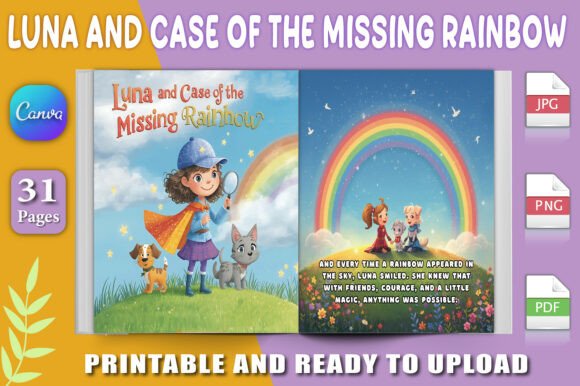
Luna and Case of the Missing Rainbow: A Sparkling Choice for Young Readers and Educators
When a child gazes up after a summer shower—not at the sky, but into a story—that’s when magic begins. Luna and Case of the Missing Rainbow isn’t just another picture book. It’s a gentle, vivid invitation into wonder: one that wraps big ideas—friendship, courage, environmental care—inside a mystery as bright and layered as a rainbow itself.
Why This Story Resonates With Ages 4–8
Children aged 4 to 8 live in a world where logic and imagination share the same playground. They ask “why” with fierce curiosity—and believe answers can come from a talking cat, a loyal puppy, or even a shy rainbow sprite. Luna and Case of the Missing Rainbow meets them right there.
The pacing is intentional: short sentences with rhythmic repetition (“Rainbow gone? Luna looked again. Still gone.”), expressive sound words (“plink-plonk!” as magic raindrops fall), and visual storytelling cues built right into the design language—like the 🌈 rainbow icon marking moments of hope, or the 🔍 magnifying glass guiding readers’ eyes to subtle clues on each page.
It works beautifully at bedtime—soft cadence, reassuring resolution—but also shines during classroom story time. Teachers report students eagerly spotting Twinkle’s 🐱 cat silhouette with twinkle star during re-reads, predicting Max’s next playful move (🐾 pawprints appear before he dashes into frame), and tracing the butterfly icon 🦋 during the rescue scene like it’s a secret map.
More Than a Story: A Tool for Emotional and Cognitive Growth
At its heart, Luna and Case of the Missing Rainbow is structured as a gentle detective journey—Luna doesn’t shout or rush; she observes, asks questions, listens closely, and teams up. That modeling matters. Early readers internalize problem-solving as collaborative, calm, and kind—not loud or solitary.
Each character carries emotional weight without heavy exposition:
- Luna wears her 🏅 guardian badge not because she’s chosen, but because she shows up—with empathy, patience, and a notebook full of sketches and questions.
- Max, the energetic puppy, teaches impulse-with-intention: his 🐶 pawprints often lead to discoveries, not distractions.
- Twinkle, the observant cat, models quiet confidence—the 🐱 silhouette with twinkle star appears beside details others miss: a bent blade of grass, a shimmer near the crystal valley, a single dewdrop holding color.
And then there’s the rainbow itself—not just decoration, but a living, breathing presence tied to balance and care. When it vanishes, the world doesn’t panic. It notices: flowers droop slightly, birds sing flatter notes, and the air feels thinner. That subtle cause-and-effect mirrors real-world ecological awareness—delivered through feeling, not facts.
Design That Serves Purpose—Not Just Pretty Pages
The KDP-ready interior isn’t just “printable.” It’s thoughtfully engineered for flexibility and function. The 31-page layout includes strategic white space—not empty, but *inviting*. Space where a child can point, pause, imagine what’s just beyond the page edge. Where a teacher can pause and ask, “What do you think Luna will find behind that fern?”
All assets—including editable Canva files—are delivered at 300 DPI, with clean white backgrounds across JPG, PNG, and PDF versions. That means no wrestling with blurry exports or mismatched crop lines. Whether you’re printing class sets, projecting during circle time, or adapting pages for AAC devices, the clarity holds.
Icons aren’t decorative flourishes—they’re semantic anchors. The 💧 magic raindrops don’t just sparkle; they signal turning points where emotion shifts or understanding deepens. The 💎 crystal icon marks the Rainbow Crystal Valley—not as a location, but as a threshold: where courage becomes action, and friendship becomes protection.
How Educators and Parents Are Using It
In kindergarten classrooms, Luna and Case of the Missing Rainbow anchors thematic units on weather, light, and community roles. One teacher laminated the 🌈 rainbow icon and used it as a “wonder token”—students passed it around to share observations or questions during science walks.
Speech-language pathologists use the dialogue-rich scenes to practice turn-taking, inferencing, and narrative sequencing. The rescue sequence—where Luna, Max, and Twinkle follow butterfly trails to restore the rainbow—offers natural opportunities to practice “first… then… finally…” language, plus rich vocabulary: glisten, ripple, tremble, unfurl.
For families, it’s become a go-to for transitions—especially after storms (literal or emotional). The 💫 sparkle stars mark moments where small choices create big ripples: Luna sharing her umbrella, Max nudging a fallen flower upright, Twinkle curling beside a shivering sprite. These aren’t grand gestures. They’re quiet, replicable acts of care.
What Makes This Stand Out in a Crowded Market
There are plenty of rainbow-themed books. What makes Luna and Case of the Missing Rainbow different is its layered intentionality—how every visual cue, word choice, and structural beat supports developmental needs without sacrificing joy.
Compare it to titles that rely on rhyme alone—or those that prioritize message over momentum. Here, rhythm serves meaning: short lines quicken during chase scenes; longer, flowing phrases slow down during moments of awe (“The valley breathed in—and out—and light poured like honey.”).
Even the subtitle—A magical children’s adventure about friendship, courage, and protecting rainbows—does double duty. It tells caregivers exactly what values are modeled. It signals teachers which SEL competencies are reinforced. And for algorithms? It nests high-intent keywords naturally: “magical children’s adventure,” “friendship,” “courage,” “protecting rainbows.”
Practical Tips for Getting the Most From Your Copy
If you’re ordering for home use:
- Read aloud with varied voices—but let pauses do the work. Try stopping just before the 🦋 butterfly icon appears. Watch how your child leans in.
- Use the 🏅 guardian badge as a conversation starter: “What does it mean to be a guardian? Of what? Of whom?”
- After reading, grab crayons and draw your own version of the Rainbow Crystal Valley. No rules—just color, shape, and what feels true.
If you’re using it in a learning setting:
- Print the editable Canva files and cut out icons to use as sorting cards: “Which icon goes with this part of the story?”
- Project the PDF interior and zoom in on one page—ask students to describe what Luna sees, hears, and feels. Then ask: “What would Max notice? What would Twinkle notice?”
- Pair it with simple science: use a prism, spray bottle, and sunlight to recreate rainbows—and talk about how light + water = magic we can understand.
A Final Thought: Magic That Lasts Beyond the Last Page
Great children’s books don’t end when the cover closes. They echo—in questions asked at dinner, in drawings taped to the fridge, in the way a child pauses mid-sprint to watch light catch a puddle.
Luna and Case of the Missing Rainbow builds those echoes deliberately. Not with flash, but with fidelity—to how young minds learn, how hearts open, and how wonder takes root in consistency, kindness, and shared attention.
That’s why educators keep it on their “core shelf.” Why parents request it by name at story hour. And why, long after the final ✨ sparkle star fades from the page, the rainbow stays—not just in the sky, but in how a child chooses to see the world.