Master Holiday Lettering with the Christmas Tracing Workbook
The Christmas Tracing Workbook bridges intention and execution in seasonal creative practice—especially for those who want to grow their hand-lettering fluency without the pressure of starting from blank space. Unlike generic holiday printables, this resource is built on pedagogical scaffolding: each page invites repetition, observation, and gradual internalization of rhythm, spacing, and stylistic nuance. It’s not just about copying—it’s about training the eye and hand to recognize what makes festive typography feel warm, balanced, and intentional.
How the Workbook Supports Skill Development
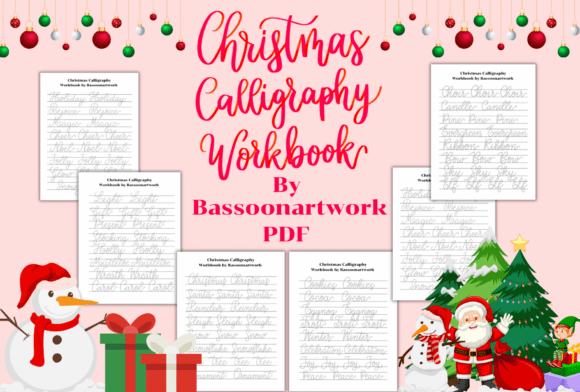
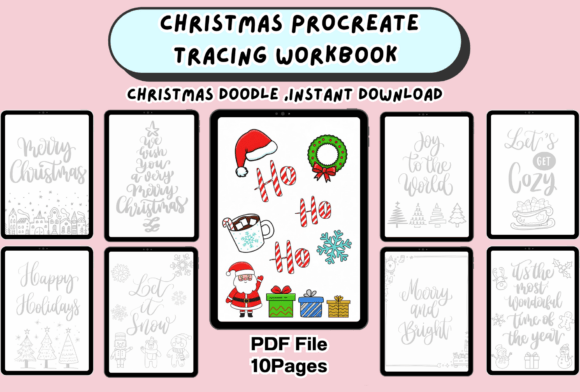
At its core, the Christmas Tracing Workbook functions as a visual and kinesthetic learning tool. The 10-page PDF includes carefully curated holiday words—“Joy,” “Noel,” “Peace,” “Believe”—and uplifting phrases like “Tis the Season to Sparkle” and “Let Your Light Shine.” Each is rendered in a clean, modern script designed for clarity and flow, with subtle variations in weight and baseline consistency that reflect professional lettering standards.
Tracing isn’t a shortcut—it’s a proven method for muscle memory development. When learners trace over well-constructed letterforms, they absorb spatial relationships: how tall ascenders should be relative to x-heights, where terminals taper, how loops connect across letters like “C” and “H” in “Christmas.” Over time, this builds confidence to experiment beyond the traced line—sketching variations, adjusting slant, or adapting forms to different media.
Because the workbook is sized at 8.5 × 11 inches and optimized for iPad use with Procreate, it supports both digital precision and tactile responsiveness. Artists can zoom in to study stroke direction, adjust brush opacity to layer tracing with freehand exploration, or duplicate pages to test color palettes and textures—all while preserving the original structure as a reference point.
Who Benefits—and How They Use It
The Christmas Tracing Workbook serves a surprisingly wide range of users—not just hobbyists seeking festive fun. Its flexibility emerges in how different audiences adapt it to their goals.
- Lettering beginners use it to build foundational control before tackling custom compositions. One educator reported assigning single-word tracing pages as warm-up exercises before group calligraphy sessions—students consistently improved baseline alignment and letter spacing within three weeks.
- Professional designers treat it as a seasonal ideation springboard. A freelance branding artist described using traced phrases as underlays for client mockups: she’d trace “Gather” in soft gold, then overlay watercolor textures and subtle shadows to generate social media banners for a boutique bakery’s holiday campaign.
- Classroom teachers integrate pages into cross-curricular lessons. In upper elementary settings, students trace “Gratitude” while writing personal reflections; in art electives, they analyze how serif vs. script treatments evoke different emotional tones—even when using the same word.
- Therapeutic practitioners incorporate the workbook into mindfulness-based art activities. The rhythmic motion of tracing slows cognitive processing, grounding participants in the present moment—a benefit noted by occupational therapists working with neurodivergent teens during holiday transitions.
- Small business owners repurpose traced elements for product design. A ceramicist scanned her traced “Merry & Bright” page, converted it to vector paths, and laser-etched the phrase onto handmade mugs—maintaining typographic integrity while scaling cleanly across curved surfaces.
Why Digital Tracing Matters in Today’s Creative Landscape
While physical tracing paper has long held value, the shift toward iPad-based workflows makes the Christmas Tracing Workbook especially timely. Procreate’s layer system allows users to separate traced guides from exploratory sketches, enabling iterative refinement without visual clutter. Brushes like “Ink Pen” or “Dry Ink” respond naturally to tilt and pressure—so learners experience realistic feedback about stroke weight and flow, mirroring traditional tools but with infinite undo capacity.
This digital context also supports accessibility. Users can increase contrast, adjust line thickness for visibility, or use assistive touch features if motor control is a consideration. One accessibility consultant adapted the workbook for a client with low vision by exporting traced layers as high-contrast SVGs, then importing them into screen-reader-compatible design software for tactile embossing.
Further, the printable nature of the file means it’s not locked to one device or platform. Educators print individual pages for in-person workshops; researchers studying handwriting acquisition use printed versions to collect analog response data alongside digital annotations; parents laminate traced sheets for dry-erase reuse during school breaks—demonstrating how a single digital asset can flex across modalities.
Design Integrity Behind the Pages
What distinguishes this Christmas Tracing Workbook from mass-produced alternatives is its attention to typographic hierarchy and seasonal authenticity. Each phrase was selected not only for lexical cheer but for pedagogical utility: “Carols” introduces challenging “C” and “R” connections; “Twinkle” offers repeated “T” shapes to reinforce consistency; “Wonder” provides opportunity to explore descending “D” forms and ligature-friendly “O-W” transitions.
The layout avoids overcrowding—ample negative space surrounds each word, reducing visual fatigue and encouraging focus on form rather than filling space. Margins are generous (0.75 inches), allowing room for notes, annotations, or experimental flourishes without cutting off critical strokes. And because the file is delivered as a standard PDF—not a flattened image or proprietary format—it remains editable in most annotation apps, supporting personalized markup and integration into existing digital workflows.
Real-World Implementation Tips
Getting full value from the Christmas Tracing Workbook depends less on frequency and more on intentionality. Here’s how experienced users maximize impact:
- Start with analysis, not tracing. Before picking up a stylus, spend 60 seconds observing the word: Where does the stroke begin? Which letters share similar entry angles? How does spacing between “S” and “T” in “Starlight” differ from “T” and “R”? This primes visual recognition before motor engagement.
- Trace with purpose—not perfection. Use light opacity (30–40%) on your tracing layer. Then create a new layer above it and sketch freely—extending swashes, testing alternate terminals, or connecting words into banners. The traced version stays as a quiet anchor.
- Rotate the canvas. For phrases like “Holiday Cheer,” rotating the iPad 90 degrees changes wrist orientation and engages different muscle groups—revealing inconsistencies in stroke control you might miss upright.
- Compare across mediums. Trace the same word once digitally, then print and trace with pencil on paper. Note differences in line confidence, pressure variation, and natural rhythm. This builds cross-platform fluency.
- Archive iterations. Save dated versions of traced pages in a folder titled “December Lettering Archive.” Reviewing progress monthly reveals subtle shifts in consistency and comfort—often more telling than any single “final” piece.
Considerations for Thoughtful Use
While the Christmas Tracing Workbook delivers strong utility, mindful application matters. It’s not a substitute for understanding fundamental principles like contrast, tracking, or optical alignment—but rather a focused drill within a broader learning ecosystem. Users aiming for professional growth should pair tracing practice with study of type anatomy, historical scripts, and contemporary lettering trends.
Licensing is another practical factor: the workbook is intended for personal and small-business commercial use (e.g., creating physical products or social content), but redistribution, resale of traced files, or use in templates offered for sale requires explicit permission. Always verify usage rights when incorporating traced elements into client deliverables or digital assets.
Finally, consider longevity. Though themed around Christmas, many phrases—“Joy,” “Hope,” “Light,” “Together”—carry resonance beyond December. Educators report reusing pages in January wellness units or spring gratitude projects by simply changing background colors or contextual framing. The workbook’s strength lies not in narrow seasonality, but in how its forms serve enduring human expression.
Building Confidence Through Repetition
Confidence in lettering rarely appears overnight. It accumulates through micro-wins: the first time a curve lands exactly where intended; the moment spacing between “M” and “E” in “Merry” feels instinctive; the realization that “Silent Night” flows more smoothly after three rounds of tracing than it did on the first attempt. The Christmas Tracing Workbook honors that progression—not as a race toward mastery, but as a series of grounded, repeatable actions that make skill tangible.
That’s why so many return to it year after year—not just for holiday prep, but as a ritual of creative reassurance. In a world saturated with complex tools and overwhelming options, sometimes the most powerful step forward is tracing a single, well-drawn word—and trusting that the next one will be just a little more certain.