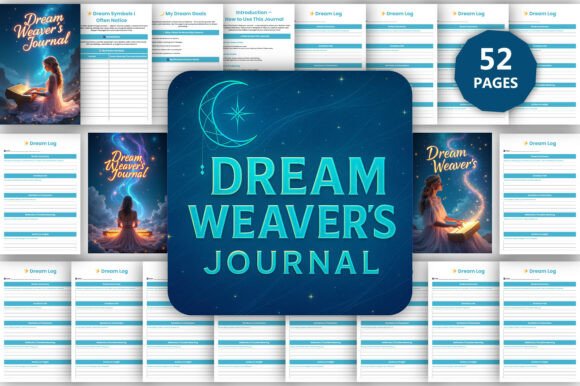
Dream Weaver’s Journal
The Dream Weaver’s Journal is a guided dream diary designed to support consistent dream recall, reflective interpretation, and pattern recognition over time. It is not a standalone dream dictionary or a clinical tool for diagnosing psychological conditions. Rather, it functions as a structured companion for individuals who already value journaling and wish to deepen their engagement with nighttime experiences in a thoughtful, non-prescriptive way.
At its core, the journal offers scaffolded writing spaces: daily log pages prompt users to record summaries, emotions, symbols, reflections, and personal takeaways. Themed prompts—such as “A Dream That Gave Me Clarity” or “A Place That Appeared in My Dream”—encourage narrative exploration beyond surface-level description. A monthly tracker supports basic trend-spotting, while dedicated symbol reflection pages invite users to assign evolving personal meaning to recurring images or motifs. The inclusion of a Dream Mood Chart (tracking emotional tones like peaceful, confused, or scared) adds a layer of affective awareness often missing from unstructured dream logging.
People often seek tools like the Dream Weaver’s Journal for several interrelated reasons. Some aim to strengthen dream recall—a skill that improves with regular, low-pressure documentation. Others are drawn to symbolic thinking and view dreams as a source of creative inspiration or intuitive insight. A subset explores mindfulness, spiritual practice, or lucid dreaming and sees dream journaling as one component of broader self-inquiry. Importantly, interest does not require belief in prophetic or literal interpretations; many users engage with dreams metaphorically, as expressions of memory consolidation, emotional processing, or cognitive rehearsal.
One clear benefit of the Dream Weaver’s Journal is its consistency. Unlike blank notebooks or digital apps with minimal structure, it reduces decision fatigue by offering focused prompts on each page. This can be especially helpful for beginners who struggle with where to begin or how much detail to include. Its thematic prompts also gently expand the scope of reflection—moving beyond “what happened” toward “what might this suggest about my current concerns, memories, or inner landscape?” The PDF format ensures portability across devices and compatibility with most note-taking apps that support annotation, though it does not include interactive features like search or auto-tagging.
However, there are tradeoffs to consider. Because it follows a fixed layout, the journal may feel restrictive for users who prefer highly personalized formats—such as those who sketch symbols, paste dream-related clippings, or integrate voice notes. It also assumes a baseline level of comfort with written reflection; individuals who find journaling laborious or emotionally overwhelming may not sustain use without additional support. Furthermore, while the journal encourages personal meaning-making, it does not provide instruction in analytical frameworks (e.g., Jungian archetypes, gestalt techniques, or cognitive-behavioral approaches to nightmares). Readers seeking formal guidance on interpretation would need to supplement it with books, workshops, or professional consultation.
Expectations matter. The Dream Weaver’s Journal will not instantly improve dream recall, resolve emotional conflicts, or produce lucid dreams. Its effectiveness depends on regular, patient use—and even then, insights tend to emerge gradually, often after several weeks or months of consistent entries. Users should anticipate variability: some nights yield vivid, memorable dreams; others bring only fragments or amnesia. The journal accommodates this reality through flexible prompts and non-judgmental framing, but it does not eliminate the natural unpredictability of dreaming.
This journal is likely a strong fit for individuals who:
- Already maintain a journaling habit and want to add dream tracking with minimal setup;
- Prefer physical or printable formats over app-based solutions;
- Value gentle scaffolding over rigid systems or clinical terminology;
- Are exploring creativity, intuition, or personal symbolism without requiring expert-led analysis;
- Seek a low-cost, accessible entry point into deeper self-reflection tied to sleep experiences.
Conversely, alternatives may be more appropriate in certain situations. For example, someone prioritizing data visualization or long-term statistical analysis of dream content might benefit more from digital tools like Dreamboard or specialized research-oriented platforms that support tagging, filtering, and export. Those working through trauma-related nightmares or persistent sleep disturbances would be better served by evidence-informed clinical interventions—such as Imagery Rehearsal Therapy—guided by a qualified mental health professional. Similarly, users seeking real-time feedback, community sharing, or AI-assisted pattern detection may find static PDF journals limiting compared to evolving digital ecosystems.
Practical decision-making starts with clarifying intent. Ask yourself: What do I hope to understand or change through dream journaling? If your goal is to notice shifts in mood or energy across weeks—or to revisit childhood imagery with curiosity—the Dream Weaver’s Journal provides a coherent, low-friction framework. If you’re testing hypotheses about dream content or need integration with other wellness metrics (e.g., sleep stage data from wearables), a more flexible or interoperable system may serve you better. Consider also your preferred medium: if handwriting feels grounding, the printable PDF works well; if typing or voice-to-text is essential, look for editable digital versions or compatible apps.
Another consideration is sustainability. A journal is only useful if used. Review the sample pages—if the tone and structure resonate, that increases likelihood of continued engagement. If the prompts feel overly prescriptive or emotionally distant, it may create friction rather than support. There’s no universal “best” journal; alignment comes from matching format to habit, intention to design, and values to execution.
In summary, the Dream Weaver’s Journal occupies a specific niche: a thoughtfully organized, symbol-aware, and emotionally attuned guide for intentional dream reflection. It does not replace professional care, nor does it promise mystical revelations. Instead, it offers a quiet, repeatable space to honor the complexity of inner experience—one night at a time. Whether it fits your needs depends less on the allure of dreams themselves and more on whether its structure supports your actual habits, goals, and capacity for sustained attention.