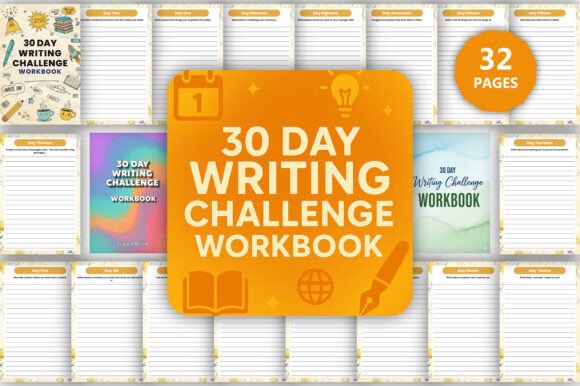
✍️ 30 Day Writing Challenge Workbook
If you’ve ever stared at a blank page wondering where to begin—or worse, skipped writing altogether because “I don’t have time” or “I’m not creative enough”—the ✍️ 30 Day Writing Challenge Workbook is built for exactly that moment. It’s not another vague self-help journal with empty lines and inspirational quotes. It’s a practical, day-by-day companion designed to meet you where you are: mid-commute, between Zoom calls, during lunch breaks, or late at night when your mind finally settles.
Each of the 30 days offers a specific, thoughtfully crafted prompt—no guesswork, no pressure to “be profound.” One day asks you to describe the smell and sound of your favorite childhood place. Another invites you to write a letter to your future self about what you hope feels easier a year from now. A third drops you into a “what if” scenario: What if your morning coffee could talk? What would it say about your habits? These aren’t arbitrary exercises—they’re entry points. And they work because they’re grounded in real human experience: memory, emotion, curiosity, small joys, quiet frustrations.
People use the ✍️ 30 Day Writing Challenge Workbook in ways that reflect their actual lives—not idealized versions of them. A freelance copywriter stuck in a creative rut opens it during her 10 a.m. reset window—not to produce client-ready content, but to reconnect with voice and rhythm. A high school English teacher prints out weekly prompts to spark low-stakes, high-engagement warm-ups—students who rarely raise their hands start sharing vivid sensory details about “a place where they felt completely safe.” A small business owner uses Day 12 (“Write about a mistake that taught you more than any success ever did”) to reflect on a recent product launch pivot—and ends up rewriting her brand’s origin story for her website.
It’s also quietly powerful in digital-first contexts. Bloggers use the “dream travel destination” prompt (Day 23) to draft evocative, SEO-friendly location-based posts—without forcing keywords. Content marketers adapt the “letter to your future self” into an email nurture sequence that builds authenticity over time. Even social media managers pull lines from their own emotional reflection entries (like Day 17: “A moment this week when I felt quietly proud”) and turn them into relatable, non-salesy captions that actually stop scrollers.
For educators, it’s classroom-ready without extra prep. No need to scaffold or differentiate—the prompts naturally scale. A student writing a simple paragraph about “my favorite thing to make with my hands” practices descriptive language. Another dives deep into “a lesson my body taught me,” weaving in metaphor and personal insight. Teachers report fewer “I don’t know what to write” comments—and more willingness to revise, share, and even read aloud.
Entrepreneurs and solopreneurs often underestimate how much mental clutter blocks clarity. The ✍️ 30 Day Writing Challenge Workbook acts like a cognitive decluttering tool. On Day 8 (“What does ‘enough’ look like in your work life right now?”), one UX designer realized she’d been measuring her value by output—not impact. That single entry led her to renegotiate project scope with a client—and reclaim 6+ hours a week. It’s not therapy, but it creates space for insight that professional coaching or strategy sessions sometimes miss.
And for everyday users—parents, caregivers, retirees, hobbyists—it meets life as it is. A new parent used Day 5 (“Describe a small ritual that grounds you”) to name the five-minute window each morning when she sips tea while watching sunrise light hit the kitchen wall. She didn’t “fix” her exhaustion—but she named something true, and that changed how she protected that time. A retiree working through Day 29 (“What’s one question you’ve stopped asking yourself—and why?”) uncovered a long-buried interest in oral history—and started recording interviews with neighbors.
What makes this different from generic journaling apps or bullet journals? Intentional scaffolding. Each prompt connects to a broader thread—gratitude, imagination, emotional honesty, storytelling—but never forces a theme. You can do Day 17 before Day 1 if you need to. You can skip a day and return without losing momentum. There’s no penalty for messy handwriting, crossed-out lines, or writing “I don’t feel like this today” and stopping there. The structure serves flexibility—not rigidity.
Before using the ✍️ 30 Day Writing Challenge Workbook, consider your current rhythm—not your aspirational one. Do you have 5 minutes most days? Great. Start there. Are you more likely to write with pen and paper, or typing on your phone? Print it, screenshot it, or use it digitally—its design works across formats. Don’t wait for “the right time.” The right time is when you pause long enough to answer, “What’s one true thing I noticed today?” That’s where Day 1 begins—and where real writing habit formation starts.
It’s also worth noting: this isn’t about building a portfolio or publishing anything. Many users never show a single entry to anyone. Yet they report sharper focus, calmer transitions between tasks, and richer conversations—with themselves and others. One marketer told us, “I stopped trying to ‘sound smart’ in emails and started writing like I talk. My open rates went up. My stress went down.” That shift didn’t come from a course or a framework—it came from writing freely, daily, without agenda.
The final reflection on Day 30 isn’t a test or summary. It’s an invitation: What surprised you? What kept showing up? What feels lighter—or heavier—than it did on Day 1? Users consistently say this isn’t about finishing. It’s about noticing patterns they hadn’t seen before: how often they default to problem-solving instead of feeling, how much joy lives in mundane details, how quickly their inner critic softens when given consistent, gentle attention.
If you're looking for a way to write regularly—not perfectly, not publicly, but meaningfully—the ✍️ 30 Day Writing Challenge Workbook fits into real life, not a productivity fantasy. It doesn’t ask you to become a writer. It assumes you already are—and helps you remember how it feels to trust your own voice, one honest sentence at a time.