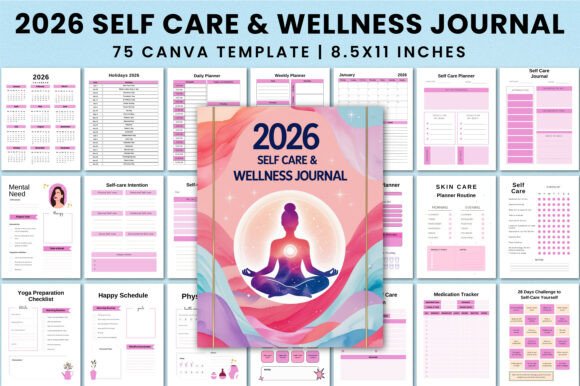
2026 Self Care Wellness Journal KDP
The 2026 Self Care Wellness Journal KDP is a purpose-built, print-ready planner designed for creators and publishers who want to offer a grounded, holistic self-care tool—without reinventing the wheel. Unlike generic journals or overly aesthetic planners, this KDP resource balances structure with flexibility, supporting intentional daily practice while remaining adaptable across diverse user needs. It’s not just another calendar—it’s a functional framework for sustained personal wellness planning in 2026.
A Structured Foundation for Real-World Use
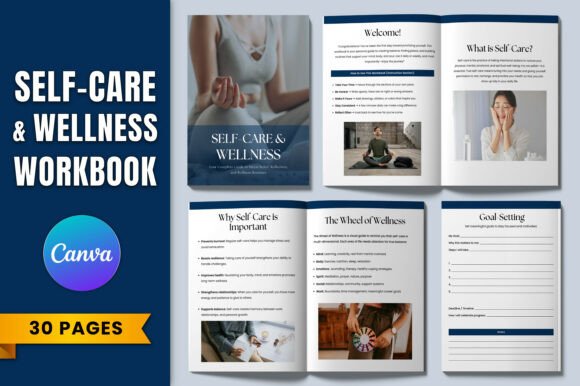
At its core, the 2026 Self Care Wellness Journal KDP delivers consistent, well-organized layouts that reflect evidence-informed wellness practices: goal setting, habit tracking, gratitude reflection, and holistic assessment. The inclusion of both weekly and monthly spreads—anchored to the actual 2026 calendar and verified U.S. holidays—means users avoid date misalignment issues common in preformatted templates. Pages like the WHEEL OF LIFE assessment and Self-Care Assessment provide measurable touchpoints, helping users identify imbalances across domains (e.g., career, relationships, physical health) without requiring external tools.
Daily prompts—such as “What nourished me today?” or “Where did I set a boundary?”—are concise but psychologically grounded, avoiding vague affirmations in favor of actionable reflection. Similarly, the 30 Day Self-Care Challenges are scaffolded: they begin with low-barrier actions (e.g., “Drink water before coffee”) and gradually introduce deeper practices (e.g., “Name one emotion I avoided this week”). This progression supports behavioral consistency rather than short-term motivation spikes.
Design Integrity and Practical Usability
From a production standpoint, the 2026 Self Care Wellness Journal KDP avoids overdesign. There are no distracting watermarks, excessive decorative borders, or cramped margins—just clean, printer-friendly pages with sufficient line spacing and intuitive section headers. The Belongs To Page, Self-Care Bucket List, and Pamper Routine spreads all use consistent typography and visual hierarchy, reducing cognitive load during daily use. Importantly, the journal leaves ample white space on tracking pages—critical for handwritten notes, checkboxes, or light sketching.
Usability extends beyond aesthetics. The Daily Self-care Planner includes dedicated slots for morning/evening rituals *and* energy-level notation—a subtle but useful feature for people managing chronic fatigue, ADHD, or demanding work cycles. Likewise, the Skin Care Planner and Pamper Routine sections acknowledge that self-care isn’t monolithic; it includes tangible, sensory routines that ground users physically—not just mentally.
Who Benefits—and How
This journal serves best when matched to realistic workflows—not aspirational ones. Freelancers juggling client deadlines and burnout risk benefit from the Weekly Self-Care Planner, which encourages time-blocking for rest *alongside* work tasks. Educators preparing for the 2026–27 school year can use the Monthly Self Care Plan to align wellness goals with academic calendars—e.g., scheduling recovery days after parent-teacher conferences or grading marathons.
Small business owners and solopreneurs find value in the Self-Care Goals and Smart Goals pages because they link intention to action: “I will take a 15-minute walk three times/week” is trackable, whereas “I’ll be less stressed” is not. Bloggers and content creators often repurpose the Self-Care Reflection and Gratitude Journal pages as raw material for authentic storytelling—without needing to fabricate vulnerability.
That said, the 2026 Self Care Wellness Journal KDP assumes baseline literacy in self-regulation concepts. It won’t teach mindfulness from scratch, nor does it include guided meditations or clinical mental health resources. Users seeking therapeutic intervention should pair it with professional support—not replace it.
Strengths in Context
One of the strongest aspects of the 2026 Self Care Wellness Journal KDP is its thematic coherence. Every section—from My Wellness Planner to Self Care Rituals—reinforces a unified definition of wellness: dynamic, multidimensional, and self-determined. There’s no prescriptive “right way” to self-care; instead, the journal invites calibration. For example, the Self-Care Intention page asks users to define what “enough” looks like *this month*, acknowledging that capacity shifts.
Its reliability also stands out. Unlike digital apps prone to updates, subscription changes, or data loss, this journal offers continuity. A user can start in January, pause in April, resume in September—and still navigate intuitively. The 2026 Calendar and Monthly Planner Jan–Dec ensure chronological fidelity, while the Self-Care Tracker uses simple icons and color-optional shading—making it accessible for users with dyslexia or low vision when printed at standard size.
Limitations Worth Noting
No planner fits every context—and the 2026 Self Care Wellness Journal KDP has boundaries worth naming. It doesn’t include digital integrations (e.g., QR codes linking to audio reflections), nor does it offer bilingual prompts or culturally adapted holiday lists beyond major U.S. observances. International sellers may need to adjust holiday references or add localization notes.
Also, while the Self-Care Bucket List encourages aspiration, it lacks built-in accountability scaffolding—like milestone check-ins or progress bars. Users who thrive on external feedback may supplement it with shared accountability partners or brief weekly reviews. Similarly, the Wellness Journal sections assume comfort with unstructured writing; those preferring sentence stems or guided questions might add their own prompts.
Long-Term Value and Strategic Fit
For KDP publishers, the 2026 Self Care Wellness Journal KDP represents a high-signal, low-churn niche asset. Demand for intentional planning tools remains steady among professionals aged 28–45—especially those who’ve cycled through productivity fads and now seek sustainability over speed. Its specificity (2026-dated, wellness-focused, KDP-optimized) reduces competition with evergreen or undated journals while maintaining shelf life through Q4 2025 and early 2026.
From a creator perspective, it’s modular enough to extend: the Self-Care Journey spread could anchor a companion workbook; the Rituals and Pamper Routine pages lend themselves to seasonal social media content; and the Wheel of Life provides natural segmentation for email list segmentation or cohort-based challenges.
In practice, the 2026 Self Care Wellness Journal KDP works best when treated as infrastructure—not inspiration. It won’t transform habits overnight, but it reliably holds space for them. When used consistently—even at 60% completion—it reveals patterns: which self-care actions actually replenish energy, which goals get deferred, where intention and execution diverge. That kind of insight, quietly accumulated over months, is where real behavioral change begins.