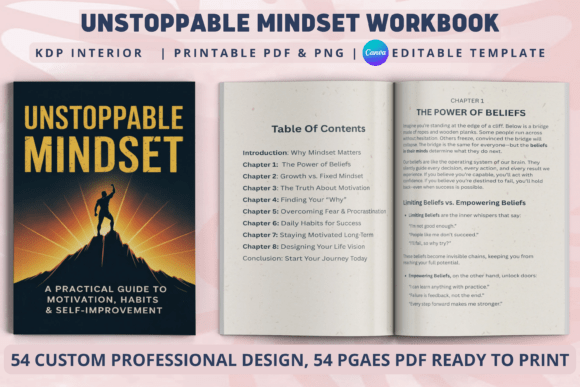
Unstoppable Mindset Workbook
You don’t need more motivation—you need better structure. More clarity. A system that works *with* your brain, not against it. That’s where the Unstoppable Mindset Workbook stands apart: it’s not another collection of abstract affirmations or vague “think positive” advice. It’s a hands-on, chapter-by-chapter toolkit designed for people who create, lead, teach, launch, and build—people who know that mindset isn’t just internal chatter. It’s the operating system behind every decision, habit, and pivot.
Each of its eight chapters functions like a workshop module—focused, sequential, and built for action. You’ll move from examining how deeply held beliefs silently shape your goals, to rewiring automatic responses to fear or delay, to designing a vision that feels personally resonant—not aspirational wallpaper. And because it’s delivered as a clean, KDP-ready 6×9” PDF, it’s equally effective printed and annotated with pen, or opened on a tablet during morning planning time.
Creative Applications Beyond Solo Journaling
The Unstoppable Mindset Workbook wasn’t designed only for quiet reflection—it thrives in collaborative, iterative, and platform-native contexts. Consider these grounded, real-world adaptations:
- Team resilience sprints: Freelancers and small studio leads use Chapter 5 (“Overcoming Fear and Procrastination”) as a 90-minute co-working session. Teams identify one shared bottleneck (e.g., client feedback delays), apply the workbook’s “fear mapping” exercise, then draft two concrete next actions—no theory, just alignment and accountability.
- Course companion material: Educators and course creators embed specific workbook prompts into their curriculum. A marketing instructor might assign the “uncover your deeper why” worksheet before students define their personal brand positioning—making abstract strategy feel anchored in purpose.
- Client onboarding tool: Coaches and consultants include selected pages (e.g., the daily habits tracker or vision design template) as part of their welcome packet. It signals rigor, invites early engagement, and surfaces client assumptions before the first call—even before the contract is signed.
None of these require permission or licensing. The workbook’s clean layout and modular structure make it easy to excerpt, adapt, or remix—so long as the core intent remains intact: helping people act with intention, not inertia.
Adapting for Different Goals—and Real Constraints
A designer launching a side project has different needs than a teacher rebuilding classroom routines after burnout. The power of the Unstoppable Mindset Workbook lies in its flexibility—not uniformity.
For creators and makers, focus lives in Chapters 4 (“Your Deeper Why”) and 7 (“Maintaining Motivation in Challenging Times”). These help clarify creative non-negotiables—what must stay true across projects—and build micro-routines (e.g., 15 minutes of unstructured sketching before checking email) that protect energy without demanding perfection.
For entrepreneurs and small business owners, Chapter 2 (“Growth vs. Fixed Mindset”) pairs powerfully with Chapter 6 (“Daily Habits”). Instead of chasing “hustle culture” metrics, users apply mindset reframes to real operational friction—like shifting from “I’m bad at sales” to “What’s one skill I can practice this week to improve outreach?” Then they anchor it with a tiny, repeatable habit: reviewing one past client testimonial every Monday morning.
For educators and mentors, the workbook’s emphasis on belief influence (Chapter 1) offers practical language for coaching conversations. Rather than saying “believe in yourself,” they guide learners through identifying a limiting statement (“I’m not the type who finishes things”) and co-creating evidence-based counterpoints (“You completed three major lesson plans last month—what supported that?”).
Keeping It Clear, Consistent, and Human-Centered
Clarity starts with format—and the Unstoppable Mindset Workbook delivers high-resolution, distraction-free pages. No decorative flourishes that compete with thought. No dense paragraphs that invite skimming. Just intentional white space, clear headings, and prompts that ask one thing at a time.
To keep results consistent, treat it like a practice—not a test. Use the same color pen each week. Keep your printed copy in the same notebook you use for project notes. If working digitally, save completed pages with dated filenames (e.g., why_worksheet_20240522.pdf). Small rituals reinforce continuity far more than grand declarations.
And to keep it human-centered? Prioritize honesty over completion. Skip a prompt if it doesn’t land. Revisit Chapter 3 (“The Truth About Motivation”) when energy dips—it reminds you that motivation follows action, not the other way around. That insight alone reshapes how you approach resistance.
Where Theory Ends and Action Begins
This isn’t about adopting a new identity (“I am unstoppable”). It’s about choosing one behavior today that aligns with the person you’re becoming. Maybe it’s using the “belief audit” worksheet to question a long-held assumption about your capacity. Maybe it’s applying the “fear-to-action” flowchart when you hesitate before sending a pitch email. Maybe it’s filling out the vision template—not to lock in a final destination, but to clarify what direction feels generative right now.
The Unstoppable Mindset Workbook works because it meets people where they are: mid-project, mid-career shift, mid-doubt—and gives them something tangible to hold, mark up, return to, and build from. It doesn’t promise overnight transformation. It offers something more reliable: a repeatable process for showing up, recalibrating, and moving forward—even when the path isn’t fully visible.
If you’ve ever paused mid-task and wondered, “Why does this feel so hard when I know what to do?”—this workbook answers that question with precision, not platitudes. It’s for the blogger refining their voice, the developer learning a new framework, the educator redesigning curriculum, the parent starting a small business after years away. It’s for anyone who knows growth isn’t linear—but believes, deeply, that it’s possible.