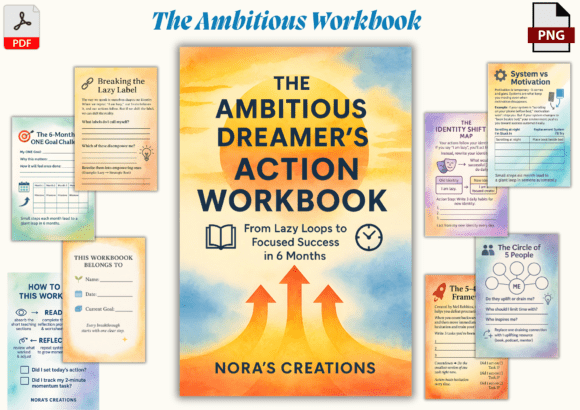
The Ambitious Dreamer’s Action Workbook
If you’ve ever stared at a blank to-do list while whispering “I’ll start tomorrow,” or deleted a half-written goal because it felt too big—or worse, too *you*—this isn’t about discipline. It’s about design. The Ambitious Dreamer’s Action Workbook meets you where you are: full of ideas, energy, and intention—but low on scaffolding. It doesn’t ask you to “try harder.” Instead, it gives you 18 interactive pages that function like a personal operating system for meaningful progress.
Why “Lazy” Is a Symptom—Not a Diagnosis
Calling yourself lazy rarely leads to change. More often, it shuts down curiosity about what’s really happening: maybe your goals don’t align with your natural energy rhythms, or your habits rely on motivation instead of systems, or your identity hasn’t caught up to the person you’re becoming. The workbook begins by gently dismantling those self-labels—not with affirmations, but with guided reflection prompts that help you trace the origin of phrases like “I’m just not consistent” or “I can’t focus.” One exercise asks you to rewrite a limiting belief in the third person (“She thinks she’s disorganized”) and then challenge it with evidence from the past week. That small shift creates psychological distance—and opens space for new behaviors.
Clarity Without Overwhelm: The 6-Month Focus Challenge
Big dreams stall when they lack proximity. The workbook’s 6-month focus challenge doesn’t ask you to map out every detail. Instead, it walks you through selecting *one* priority area—like launching a course, improving client communication, or building a sustainable creative practice—and breaking it into quarterly themes, monthly anchors, and weekly “micro-actions.” A freelance writer used this to move from vague plans (“write more”) to concrete steps (“draft one newsletter intro per week using voice notes during my 10 a.m. energy peak”). The structure prevents decision fatigue and keeps attention anchored in what’s doable *now*, not what’s possible in five years.
Systems Over Sparks: Rewiring How You Show Up
Motivation fades. Systems endure. The workbook includes visual tools that reframe habit-building as environmental design—not willpower. Its “System vs. Motivation” worksheet helps you audit daily routines: Where do friction points live? (e.g., needing to open three apps to journal). Where can you lower the barrier? (e.g., keeping a notebook by your morning coffee). It also introduces the 2-Minute Rule habit grid, where each cell represents a tiny action tied to an existing cue—“After I pour tea → write one sentence about today’s intention.” This isn’t about volume; it’s about consistency that compounds quietly over time.
Energy Alignment > Time Management
For creators, educators, and entrepreneurs whose work depends on mental stamina, rigid schedules often backfire. The workbook includes energy alignment trackers designed around natural cycles—not arbitrary hours. There’s space to log focus quality, creative flow, physical energy, and emotional bandwidth across days and weeks. One educator noticed her best lesson-planning happened mid-afternoon—not during “prime productivity hours”—and adjusted her calendar accordingly. Another freelancer synced deep-work blocks with her menstrual cycle’s follicular phase, reporting sharper clarity and fewer revisions. These aren’t prescriptive rules; they’re invitations to observe and honor your own rhythm.
Identity Shifts That Stick
You don’t become a writer by finishing a novel. You become one by showing up as a writer—repeatedly, even imperfectly. The workbook embeds identity-based habit frameworks that ask: “What would a person who *already is* [your goal] do in this situation?” Not “How do I write more?” but “What does a curious, process-oriented writer do when inspiration feels thin?” The answer might be reviewing old notes, sketching rough outlines, or reading one page of craft literature. These micro-choices reinforce who you’re growing into—not just what you want to achieve.
Reflection That Builds Momentum—Not Guilt
Most planners end with tracking. This one ends with *celebration*. The reflection review pages guide you to notice growth in overlooked areas: Did you speak up in a meeting after practicing boundary-setting language? Did you rest without shame when energy dipped? Did you revise a goal—not as failure, but as recalibration? One small business owner realized her “lack of progress” was actually a pivot toward more aligned services. That insight wouldn’t have surfaced without structured reflection space that values nuance over checkboxes.
Who Benefits Most—and When to Pause and Consider Alternatives
This workbook shines for people who thrive with tactile, visual, and reflective tools—especially those who’ve tried generic habit trackers or goal-setting templates and felt disconnected from the process. It’s especially helpful for freelancers managing unpredictable workloads, educators balancing creativity with administrative demands, or side-hustlers juggling full-time roles. That said, if you prefer audio-based learning, real-time coaching, or highly collaborative accountability, the workbook works best alongside those supports—not as a replacement. It’s also not built for teams or complex project management—it’s deeply personal, intentional, and self-directed.
A Certificate That Means Something Real
The final page—a Certificate of Transformation—isn’t symbolic fluff. It’s signed *by you*, after completing the full sequence. One user described signing it after her third round of the 6-month challenge: “It wasn’t about finishing. It was about proving to myself I could return—even after setbacks—and trust the process again.” That kind of embodied confidence doesn’t come from external validation. It comes from repeated, supported action.
Practical Details That Support Real Use
Designed at 6x9 inches, the workbook fits easily into a bag or beside a laptop. The PDF and PNG formats mean you can print it for handwriting or load it into note-taking apps like GoodNotes or Notion for digital use. Each page is intentionally uncluttered—no decorative distractions, just clean lines, thoughtful spacing, and intuitive layouts. And because it’s only 18 pages, it avoids the overwhelm of massive planners. You don’t need to “get through” it—you engage with what serves you, revisit sections as needed, and let the rest wait.
The Ambitious Dreamer’s Action Workbook won’t magically erase procrastination. But it does something more useful: it replaces self-judgment with gentle structure, vague desire with tangible experiments, and isolation with quiet companionship in the work of becoming. Progress isn’t always loud. Sometimes, it’s the soft click of a pen filling in a 2-minute habit grid—or the pause before deleting a draft, choosing instead to write one honest sentence about what matters right now.