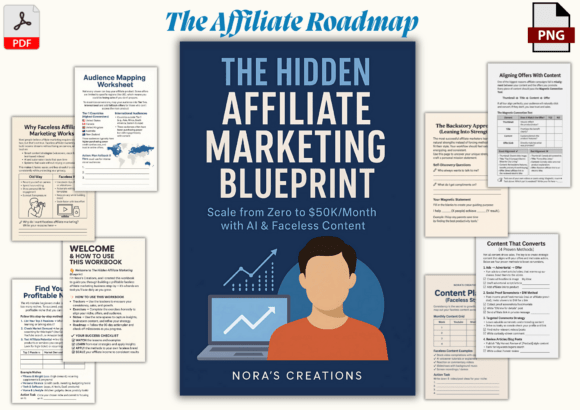
The Affiliate Roadmap Workbook
If you’ve ever stared at a blank content calendar, second-guessed which niche to pursue, or felt stuck choosing between ten different affiliate programs—this workbook meets you where you are. The Affiliate Roadmap Workbook isn’t another dense theory guide or a vague motivational checklist. It’s a 17-page, 6x9-inch practical companion built for real work: planning, reflecting, and progressing—without distraction.
Clarity Over Complexity
Affiliate marketing doesn’t require advanced tech skills—but it does demand clear direction. Many beginners spend weeks researching tools, comparing platforms, or drafting posts without a cohesive strategy. That’s where this workbook helps: it starts with foundational questions—not assumptions. Pages guide you through defining your audience’s core problems before selecting products, not the other way around. One section asks, “What do people in your niche search for *right before* they buy?” That small prompt shifts focus from “what pays well” to “what solves urgently”—a subtle but critical distinction that improves relevance and trust.
Time-Saving Structure for Real Schedules
You don’t need hours to benefit. Because it’s intentionally compact (just 17 pages), The Affiliate Roadmap Workbook avoids overwhelming detail while preserving substance. Each spread has one primary action: map your first three content pillars, rank potential niches using simple scoring criteria (audience size, competition, personal alignment), or sketch a 30-day promotion rhythm. There’s no filler—just prompts designed to be completed in 20–45 minutes, whether you’re a full-time educator building a side income or a freelance writer testing monetization.
Tracking That Actually Fits Your Workflow
Most trackers assume you’ll log daily metrics in spreadsheets. This workbook uses reflection-based progress tracking instead. A two-column table asks you to note: What I tried and What I learned—not just clicks or conversions. That approach works especially well for bloggers who publish weekly, podcasters launching seasonal campaigns, or educators sharing affiliate resources within course communities. You’re not measuring output alone—you’re capturing insight, which builds better judgment over time.
Design That Supports Consistency
The clean, uncluttered layout isn’t just aesthetic—it reduces cognitive load. Icons (like 🛠️ for planning steps or 📈 for review sections) act as visual anchors, helping your eye land on the right tool when energy is low. And because it’s delivered in both PDF and PNG formats, you can print a single page to pin above your desk, drop a section into Notion as a recurring template, or annotate digitally during a quiet morning planning session. That flexibility means consistency isn’t dependent on perfect conditions—it’s supported by design.
Who Benefits Most—and Why
The Affiliate Roadmap Workbook serves people who value intentionality over speed. It’s ideal for:
- Bloggers and content creators who already produce helpful material but haven’t systematized how affiliate offers fit naturally into their voice or editorial flow;
- Educators and coaches who recommend tools to students or clients and want a repeatable method for vetting and presenting those recommendations ethically;
- Freelancers and solopreneurs exploring diversified income—especially those wary of “get rich quick” noise and seeking grounded, step-by-step scaffolding;
- Small business owners adding affiliate partnerships to an existing product or service—using the workbook to align promotions with customer journey stages rather than random placements.
It’s less suited for teams needing enterprise-grade reporting or marketers already running multi-channel campaigns with dedicated analytics stacks. If you’re deep in A/B testing funnels or managing large-scale influencer collaborations, this workbook complements—but doesn’t replace—those systems. Its strength lies in grounding early- and mid-stage efforts, not scaling complex infrastructures.
Practical Integration, Not Isolation
Think of this workbook as a co-pilot—not a GPS that reroutes you every mile. You might use Page 5 (“Niche & Product Fit Scorecard”) while reviewing Amazon Associates categories before committing to a new review series. Or fill out the “Content-Promotion Alignment Grid” (Page 11) after drafting a YouTube script, asking: Does this segment introduce the problem, demonstrate the solution, or reinforce trust? Where does the affiliate link belong—not just logically, but ethically?
One user—a yoga instructor launching a wellness blog—used the reflection prompts to realize her strongest conversions came not from gear roundups, but from “how I solved my own back pain” stories featuring specific mats and posture aids. That insight emerged directly from journaling in the workbook—not from chasing trends.
Realistic Expectations, Real Progress
This workbook won’t guarantee income. But it does reduce common friction points: the paralysis of too many options, the inconsistency of sporadic posting, the misalignment between what you promote and what your audience truly needs. By focusing on one decision at a time—with space to write, revise, and reflect—it supports sustainable habits over short-term spikes.
For example, the “Promotion Cadence Planner” doesn’t ask you to schedule 90 days of posts. It asks you to block out just three touchpoints across a month—say, a newsletter mention, a pinned social post, and a resource page update—then evaluate what resonated. That constraint fosters learning, not burnout.
A Tool That Grows With You
Even experienced affiliates report returning to the workbook during strategy resets—especially the “Growth Tracker” section. Revisiting past reflections surfaces patterns: maybe certain content formats consistently earn higher engagement, or particular affiliate networks align more closely with audience values. Because the format is printable and digital-friendly, it adapts as your goals evolve—from validating a single offer to building a portfolio of trusted recommendations.
Ultimately, The Affiliate Roadmap Workbook matters because it treats affiliate marketing as a practice—not a tactic. It assumes you care about serving your audience well, and that sustainable income follows clarity, consistency, and thoughtful iteration. No jargon. No fluff. Just 17 pages designed to help you start where you are, use what you have, and move forward with purpose.