Etsy Keyword Research Workbook: Stop Chasing Scores, Start Finding Real Buyers
If you’ve ever stared at an Etsy keyword tool, refreshed your listing stats for the third time today, or felt quietly defeated after optimizing for “perfect” scores that brought zero clicks—this isn’t just another workbook. The Etsy Keyword Research Workbook and its companion, ✨ Beyond Keyword Scores Etsy Keyword Research Secrets Workbook ✨, are built for sellers who’ve realized something critical: high scores don’t equal sales—but real demand does.
When “Good Enough” Keywords Outsell “Perfect” Ones
Imagine this: You’re launching a set of minimalist ceramic planters. Your keyword tool flags “boho plant pots” as high-volume and low-competition—great score! But when you search it on Etsy? Page one is flooded with $80+ pieces, most with 500+ reviews and shops active since 2017. Meanwhile, “small stoneware planter no drainage” has a “mediocre” score—yet shows 12 recent listings from new shops, all with in-cart tags, 4-star+ reviews mentioning “perfect for succulents,” and bestseller badges appearing on three of them in the last 30 days. That’s not noise—that’s opportunity.
This workbook helps you spot those hidden gems. It doesn’t ask you to ignore data—it teaches you to read *between* the data. You’ll learn how to use EverBee clues (like “recently trending,” “low stock alerts,” or “frequent re-lists”) not as footnotes, but as frontline signals of unmet demand.
Real People, Real Scenarios—Where This Workbook Fits In
- The New Seller Launching Their First Shop: You’re excited—but overwhelmed by advice telling you to “do keyword research” without showing *how*. This workbook walks you through validating demand *before* you list a single item. Example: Instead of guessing what “wedding guest book alternative” might mean, you’ll learn to scan top-performing listings, check review phrases (“used it as our mountain elopement guest book”), and spot gaps—like zero options for vegan leather covers with trail map engraving.
- The Seasoned Seller Stuck in a Traffic Rut: You’ve optimized titles, refreshed tags, even tried A/B testing thumbnails—and still see flat impressions. The workbook shifts your focus from *keywords alone* to *product context*. You’ll analyze what makes a bestseller *actually sell*: Is it bundling (“candle + matchbox + striker card”)? Timing (“back-to-school printable planner” spikes mid-July, not August)? Or subtle trust cues (“hand-poured in Portland” in the first line of description)?
- The Creative Who Hates “SEO Stuff”: You love making—and hate spreadsheets. Good news: this isn’t about drowning in metrics. It includes reflection prompts like, “What’s one thing customers *always* ask you about?” or “Which item gets the most DMs asking ‘Can you make this in blue?’”—then shows you how to turn those organic questions into high-intent keywords and SEO-ready titles (13 tags included, no guesswork).
Why New Shops Are Your Secret Demand Radar
Here’s something most keyword tools won’t tell you: a brand-new shop with 3 listings and 12 sales in 2 weeks is stronger proof of opportunity than a 5-year-old shop with 2,000 sales. Why? Because Etsy’s algorithm rewards freshness—and if a newcomer is gaining traction fast, it means demand is *current*, not legacy. The workbook guides you through spotting these signals: sudden bestseller badges on new listings, repeat buyers leaving identical 5-star reviews across multiple new shops (“exactly what I needed for my tiny home office!”), or in-cart tags appearing within hours of relisting.
One seller used this method to pivot from generic “gold hoop earrings” to “14k gold-filled small hoops for sensitive ears”—a phrase buried in customer reviews, not keyword tools. She added it to her title, updated two tags, and saw impressions jump 68% in 10 days. Not because the score was higher—but because it matched *real language* people used while actively buying.
Practical Considerations Before You Dive In
This workbook works best when you’re ready to observe—not just optimize. It’s not magic, and it won’t replace good photography or clear policies. But it *will* help you avoid common traps:
- Over-relying on volume numbers: “Wedding invitations” has massive search volume—but also thousands of competitors and high buyer expectations. The workbook helps you drill down to sub-niches like “rustic wedding invitation suite editable Canva” where buyers are further along in their decision journey.
- Ignoring seasonal rhythm: Some keywords spike predictably (e.g., “teacher appreciation gift” peaks March–April), while others respond to cultural moments (“Barbiecore nail stickers” surged post-movie release). You’ll learn to layer timing into your research—not just “what’s searched,” but “when it’s *most likely to convert.”
- Skipping the human layer: Reviews, Q&A sections, and even competitor shop announcements (“Now offering rush shipping!”) hold gold. The workbook includes trackers to log recurring phrases, pain points (“wish it came in larger size”), and emotional triggers (“made my graduation day so special”).
Strengths—and What It Doesn’t Do
Its biggest strength? It bridges intuition and analytics. You’ll learn to trust your gut *and* back it up—like noticing a trend in your own DMs, then using the workbook’s validation steps to confirm whether it’s isolated or widespread.
What it doesn’t do: It won’t auto-generate listings for you. It won’t guarantee page-one rankings. And it doesn’t promise overnight results—because real demand discovery takes observation, not automation. But it *does* give you a repeatable system: track → validate → test → refine. One seller used the 7-Day Etsy Research Challenge to identify three under-served niches in her embroidery niche—and launched all three listings in under two weeks. Two hit bestseller status within a month.
Your Next Step Isn’t More Data—It’s Better Questions
The Etsy Keyword Research Workbook reframes everything. Instead of asking, “What keywords have the best score?” you start asking:
- “What are buyers *actually saying* in reviews and messages?”
- “Which new shops are quietly winning—and what can I learn from their product framing?”
- “Where is demand *happening right now*, not just historically?”
- “How can I turn a customer question into a full SEO-ready title and tag set—in under 10 minutes?”
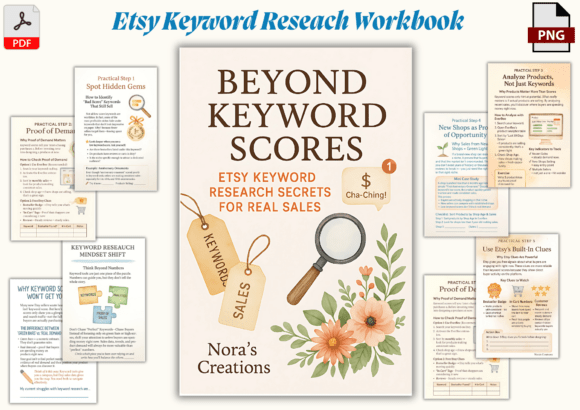
It comes as a clean, portable 6x9 PDF (with PNG backup), 17 pages designed for writing, circling, and reflecting—not just reading. And yes—the Certificate of Completion isn’t just for show. It’s proof you’ve moved past score-chasing and started building a research habit that compounds: every insight feeds the next launch, every validated keyword sharpens your intuition, and every new shop you study becomes part of your live demand radar.
Because on Etsy, the most valuable keywords aren’t the ones with perfect scores—they’re the ones already in someone’s cart.