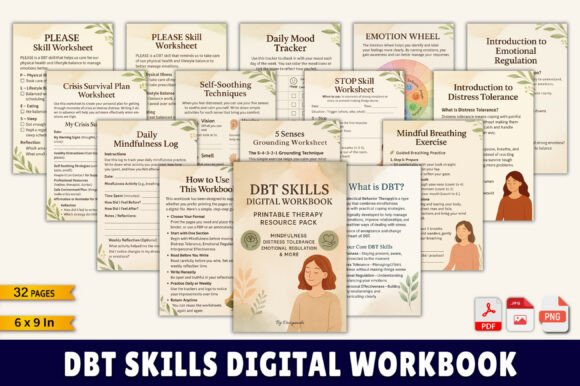
DBT Skills Digital Workbook
If you’ve ever felt overwhelmed by emotions, struggled to stay present during a busy day, or wished you had clearer tools to navigate conflict or stress — the DBT Skills Digital Workbook offers something tangible. It’s not an app that pushes notifications or a course that demands hours of video watching. Instead, it’s a quiet, thoughtful companion: a printable, adaptable, and grounded set of worksheets rooted in Dialectical Behavior Therapy (DBT), designed for real-life use — not theory alone.
What This Workbook Actually Is — and Isn’t
The DBT Skills Digital Workbook is a 6 × 9-inch PDF resource with 30 guided exercises across five core DBT skill sets: mindfulness, distress tolerance, emotional regulation, interpersonal effectiveness, and grounding. Each worksheet includes space to write, reflect, and apply — no assumptions about prior knowledge. There are no quizzes, no gatekeeping, and no requirement to “keep up.” You move at your pace, revisit pages as needed, and choose what resonates — today or six months from now.
It’s not a replacement for therapy — but it *is* a bridge. For someone just learning about emotional regulation, it offers structure without pressure. For someone who’s read DBT books but hasn’t practiced consistently, it turns insight into action. And for those supporting others — educators, coaches, counselors — it’s a ready-to-use, ethically grounded tool they can share without needing licensing or training.
Why It Fits Different Lives — Differently
A freelance graphic designer might open the workbook after a tense client call, using the “STOP” skill page to pause before replying to an email. A high school teacher could print the boundary-setting prompts to prepare for a difficult parent conversation. A small business owner recovering from burnout may turn to the grounding worksheets each morning — not to fix everything, but to reconnect with their breath before checking messages.
What matters most shifts depending on where you are:
- Beginners often prioritize clarity and low friction. The DBT Skills Digital Workbook avoids clinical jargon and starts with concrete actions — like naming three things you see, hear, and feel — making it accessible even if you’ve never heard of “radical acceptance.”
- Experienced practitioners value depth and flexibility. They appreciate that the reflection journaling pages don’t prescribe answers but invite honest noticing — “What happened right before I shut down?” or “When did I last honor a ‘no’ without guilt?” — allowing integration with existing frameworks.
- Creatives and educators look for presentation quality and adaptability. The clean, minimalist layout works equally well printed, imported into Goodnotes, or projected during a workshop. PNG and JPG files mean they can drop exercises into slides, social posts, or handouts — ethically and respectfully.
- Professionals managing chronic stress care about reliability and speed. Because it’s a downloadable PDF, there’s no login, no subscription, and no loading time. Open it, pick one page, and begin — even during a 15-minute lunch break.
Practical Use Across Real Scenarios
Consider Maya, a content marketer who experiences anxiety before team presentations. She uses the “TIPP” exercise (Temperature, Intense exercise, Paced breathing, Paired muscle relaxation) from the distress tolerance section — not as a cure, but as a reset button she can access offline while waiting in the conference room.
Then there’s Javier, a community college instructor teaching wellness electives. He adapts the mindfulness tracking sheet into a low-stakes class activity — students log one mindful moment per day for a week, then discuss patterns in small groups. No extra prep, no tech barriers, and it aligns with evidence-based SEL standards.
And Lena, a ceramic artist running her own studio, prints the interpersonal effectiveness worksheets to review before vendor negotiations. She highlights phrases like “DEAR MAN” (Describe, Express, Assert, Reinforce, Mindful, Appear confident, Negotiate) — not to sound scripted, but to remember her goals and stay grounded when stakes feel high.
What Makes It Work Over Time — Not Just Once
Long-term usefulness isn’t about volume — it’s about resonance. The DBT Skills Digital Workbook avoids overloading users with 100+ pages of dense material. Its 6 × 9-inch size fits comfortably in a bag or on a nightstand. The printable format means you can annotate freely, tear out a page for your desk, or keep a fresh copy in your digital planner each month.
It also honors different learning rhythms. Some people absorb best by writing; others benefit from visual cues. That’s why the workbook includes both structured prompts (“Name one emotion you’re avoiding — and one small way you could gently notice it”) and open-ended reflection spaces (“What does safety feel like in your body right now?”). There’s no “right” answer — just space to discover your own.
How to Know If It’s Right for You
You might find the DBT Skills Digital Workbook especially helpful if:
- You want skills — not just explanations — and prefer learning by doing rather than listening or reading long texts.
- You value autonomy: choosing which skill to practice, when, and how deeply — without external deadlines or performance metrics.
- You’re looking for something that supports mental wellness without pathologizing everyday experience — no diagnosis required, no labeling needed.
- You need flexibility across formats: paper for tactile processing, digital for portability, or both.
- You appreciate materials designed with care — clean typography, intentional spacing, and inclusive language that assumes competence, not deficiency.
It’s less ideal if you’re seeking live coaching, group accountability, or AI-driven personalization. It doesn’t replace therapeutic support for complex trauma or acute crisis — but it *does* meet people where they are: in the quiet moments between meetings, during early-morning stillness, or late at night when thoughts spiral and you just need one clear step forward.
A Tool That Grows With You
People often assume emotional skills are “fixed” — something you either have or don’t. But research shows they’re more like muscles: strengthened through repetition, adjusted with experience, and responsive to context. The DBT Skills Digital Workbook supports that growth precisely because it doesn’t demand perfection. You can return to the same grounding page three times in one week — and each time, notice something new. You can skip sections, dog-ear pages, or leave them blank until the timing feels right.
Whether you're building resilience after life changes, deepening self-awareness as part of creative work, or simply wanting to respond — not react — more often, this workbook meets practical need with quiet consistency. It doesn’t shout. It doesn’t promise transformation overnight. But it does offer something steady, usable, and human — exactly when you need it most.