Assertive Communication Workbook
Speaking up without guilt. Saying “no” without apology. Expressing needs clearly—without escalation or withdrawal. These aren’t personality traits reserved for the naturally confident. They’re skills. And the Assertive Communication Workbook is designed to help adults aged 20–50 build them deliberately, step by step—whether you’re navigating a tense team meeting, setting limits with a family member, or launching your first KDP self-publishing project.
Why clarity in communication starts with structure—not willpower
Many people know *what* assertiveness feels like in theory: calm, direct, respectful. But translating that into real-time exchanges—especially under stress—is where most stumble. The Assertive Communication Workbook bridges that gap not with abstract advice, but with scaffolded practice. It begins by grounding users in the practical differences between passive, aggressive, and assertive styles—not as labels, but as observable patterns in language, tone, and body language. That distinction matters because misidentifying your own default style can stall progress before it begins. A freelancer who mistakes people-pleasing for professionalism may overcommit silently, then resent clients later. A teacher who defaults to sharp corrections may unintentionally shut down student input. This workbook helps name those habits—and replace them with intentional alternatives.
Real practice, not just theory
Each page serves a purpose: no filler, no vague affirmations. The “I” statement templates, for example, go beyond “I feel…” fill-in-the-blanks. They guide users to separate observation from interpretation (“When the deadline was moved twice without discussion…”), name the impact (“…I felt unsure how to prioritize my workload”), and state a need or request (“…could we agree on one final date before I begin drafting?”). That structure reduces defensiveness in others and sharpens self-awareness in the speaker.
Role-play scenarios mirror everyday tensions: declining extra work during a busy quarter, asking a roommate to clean up shared spaces, giving constructive feedback to a peer. These aren’t hypotheticals—they’re drawn from common friction points professionals and creatives report. The reflection prompts that follow each scenario ask targeted questions: *What did your voice sound like? Where did you feel tension? What would one small shift change next time?* That metacognitive layer turns practice into lasting skill.
Built for creators—and those who support them
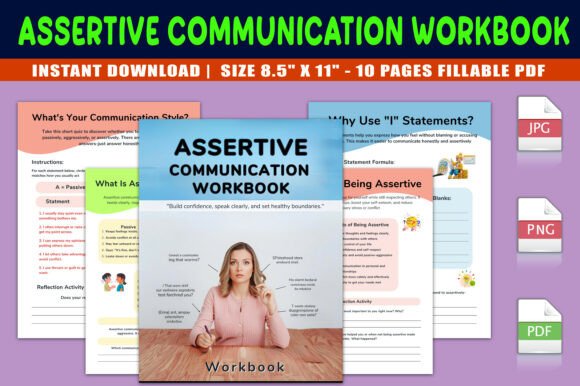
The interior design reflects its audience. At 10 clean, 8.5 x 11-inch pages, it’s optimized for both digital use (on tablets or laptops during coaching sessions) and physical printing (for journaling or workshop handouts). The editable Canva files let educators, coaches, or indie publishers adapt layouts—adding their logo, adjusting spacing for accessibility, or scaling fonts for older readers—without wrestling with complex design software. The 300 DPI JPG and PNG exports ensure crisp reproduction whether used in a printed client packet or embedded in an online course module. And because it’s ready-to-upload PDF interior format, KDP sellers avoid last-minute formatting errors that delay publishing.
Nonverbal cues matter—so the workbook addresses them directly
You can craft a perfect “I” statement and still undermine it with crossed arms, averted eyes, or a voice that trails off at the end. That’s why the Assertive Communication Workbook includes a concise yet actionable guide to assertive body language—not as rigid rules, but as awareness anchors. It explains how upright (not stiff) posture supports vocal resonance, how steady (not unblinking) eye contact builds credibility, and how pausing—even half a second—before responding signals presence, not hesitation. These aren’t performative tricks. They’re physiological supports for authentic expression.
Who benefits most—and when it’s worth considering alternatives
This workbook fits especially well for professionals who juggle multiple roles: solopreneurs negotiating contracts while managing client expectations; educators balancing administrative demands with student advocacy; marketers advocating for creative direction amid tight deadlines. Its strength lies in immediacy—it doesn’t require weeks of reading or daily 30-minute drills. Ten focused pages mean users can complete one section before a meeting, reflect after a difficult conversation, or revisit boundary scripts when preparing for a performance review.
That said, it’s not a substitute for clinical support if communication challenges stem from trauma, neurodivergence, or deep-seated anxiety disorders. In those cases, pairing this workbook with guidance from a licensed therapist or speech-language pathologist often yields stronger, more sustainable outcomes. Likewise, teams seeking organization-wide change will need facilitated workshops—not just individual tools. But for someone ready to start small, with clear scaffolding and zero fluff, the Assertive Communication Workbook meets them where they are.
Small shifts, measurable impact
One user—a freelance graphic designer—reported using the boundary-setting scripts to renegotiate scope creep on three active projects. She didn’t fire clients; she clarified deliverables, timelines, and revision limits—then documented them. Result? Fewer after-hours emails, clearer contracts, and two repeat bookings within six weeks. Another—a high school counselor—integrated the reflection prompts into her weekly prep routine. Noticing patterns in how she responded to escalated student conflicts helped her adjust tone and pacing before entering those conversations—reducing emotional exhaustion and improving resolution rates.
These aren’t outliers. They reflect what happens when communication moves from reactive habit to practiced skill: less mental energy spent rehearsing conversations in your head, more bandwidth for listening, creating, and leading.
What’s included—and why the details support real use
The bonus pages aren’t decorative extras. One offers a quick-reference checklist for pre-conversation grounding—breathing cues, posture reminders, and a single anchor phrase (“I’m here to understand and be understood”). Another provides space to draft personalized boundary scripts for recurring situations: social invitations, workplace requests, or family obligations. Because consistency compounds, not intensity.
The clean white background across all file formats isn’t just aesthetic—it ensures readability for screen readers, compatibility with print-on-demand systems, and flexibility for users who want to add color or branding later. And the fully organized layout means no hunting for exercises: each tool appears where it’s most relevant, supporting flow rather than interrupting it.
If you’ve ever walked away from a conversation thinking, *“I wish I’d said…”*—this workbook gives you the framework to close that gap. Not perfectly. Not overnight. But steadily, with clarity, and with respect—for yourself and others.