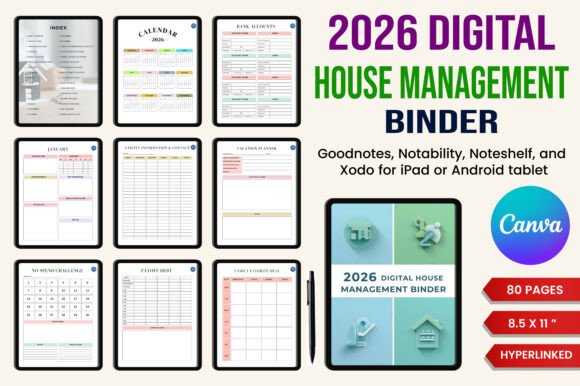
2026 Digital House Management Binder: The Central Operating System for Modern Household Coordination
Managing a household in 2026 is no longer just about calendars and grocery lists—it’s about integrating systems. Between remote work schedules, hybrid school calendars, fluctuating utility rates, evolving dietary needs, and the rising cost of home maintenance, fragmentation is the default state for most families and solo households alike. That’s where the 2026 Digital House Management Binder shifts from convenience to necessity: it functions not as another app or spreadsheet, but as a unified, editable, human-centered operating system for domestic life.
Why Integration Outperforms Isolation
Most households juggle at least five disjointed tools: a shared calendar (Google or Outlook), a notes app for meal ideas, a banking app for bills, a paper chore chart on the fridge, and a mental list of when the HVAC filter was last changed. Each tool solves one problem—but creates friction elsewhere. A missed bill isn’t just about late fees; it’s about context collapse—when your “bill tracker” lives in Excel, your “vacation budget” lives in Notes, and your “kids’ soccer schedule” lives in TeamSnap, nothing connects. The 2026 Digital House Management Binder eliminates that siloing by design. Its architecture assumes interdependence: your meal plan informs your grocery inventory, which feeds into your monthly expense log, which ties back to your savings goal tracker—all within the same navigable document set.
Real-World Workflows, Not Just Features
Consider how a working parent might use the binder across a single week:
- Monday morning: Opens the Monthly Planning spread to review upcoming appointments (dentist, teacher conference), cross-checks the Family Activity Planner for overlapping commitments, then adjusts the Dinner Menu to avoid cooking on Wednesday—the night of the PTA meeting.
- Tuesday evening: Updates the Freezer & Pantry Inventory after restocking, triggering an automatic mental note (and later, a formal entry) to reorder rice, canned beans, and oat milk—entries that populate the Household Supplies Reorder List, synced with their monthly expense tracker.
- Thursday afternoon: Reviews the Home Maintenance Responsibility Chart, sees that outdoor gutter cleaning is due, assigns it to their teen (with agreed-upon compensation logged in the Family Event Budget section), and logs the task completion in the Habit Tracker to reinforce consistency.
- Saturday: Uses the Goal Tracker to reflect on progress toward their $500 emergency fund target, compares actual spending against the Bill Tracker and Debt Payment Log, then adjusts next month’s grocery budget accordingly—changes reflected instantly across linked sections.
This isn’t theoretical. It mirrors how educators coordinate volunteer sign-ups with classroom supply deadlines, how small business owners separate personal utilities from home-office expenses, and how retirees manage seasonal home upkeep while tracking prescription refills and doctor visits. The 2026 Digital House Management Binder supports these variations not through rigid templates, but through semantic structure—each section is designed to reference, inform, and update others without manual duplication.
Design Intelligence Behind the Simplicity
The binder’s effectiveness stems from deliberate, research-informed choices—not just aesthetic polish. Its 8.5×11 inch page size ensures compatibility with standard printers and digital annotation tools (like GoodNotes or Adobe Acrobat), while its editable Canva link offers customization without requiring design expertise. Unlike static PDF planners, this system lets users rename tabs, reorder pages, add custom fields (e.g., “Allergy Notes” beside school lunch menus), or duplicate spreads for multi-home scenarios (e.g., rental property + primary residence).
The inclusion of 80 distinct Canva templates matters more than quantity suggests: they cover edge cases rarely addressed elsewhere—like a Gift Planning Matrix that tracks recipient preferences, past gifts, budget allocation per occasion, and purchase deadlines; or a Creative Space layout optimized for bullet journaling, mind-mapping, or visual goal setting—not just lined pages. These aren’t decorative extras. They respond to observed gaps: professionals needing space to log continuing education credits alongside family obligations; creators managing Patreon income alongside household expenses; researchers tracking grant deadlines alongside school drop-off times.
Financial Clarity Without Accounting Overhead
Finance tracking in the 2026 Digital House Management Binder avoids overwhelming complexity while delivering actionable insight. Instead of requiring double-entry bookkeeping, it uses progressive disclosure: start with the Bill Tracker (due dates, amounts, payment method), then layer in the Income & Expense Log (categorized by source and purpose), then connect both to the Savings & Emergency Fund Log. This reveals patterns—e.g., “Grocery spending spikes 23% in months with three weekend birthdays”—without demanding accounting software fluency.
Crucially, it normalizes financial transparency across age groups. Teens can log allowance earnings and savings goals in the same format adults use for mortgage payments. Grandparents co-managing care for aging parents can adapt the Event Budget template for medical appointment logistics—transport, co-pays, follow-up prescriptions—without exposing sensitive health data in public-facing apps.
Maintenance as Prevention, Not Reaction
The Home Maintenance section reframes upkeep from chore to continuity planning. Indoor checklists include seasonal HVAC filter swaps, smoke detector battery replacements, and window seal inspections—timed to coincide with daylight saving shifts or tax season reminders. Outdoor trackers prompt gutter cleaning before fall leaf accumulation, deck sealing before summer humidity peaks, and irrigation system winterization aligned with local freeze dates.
What makes this practical is the Responsibility Chart: not just names beside tasks, but columns for “Last Completed,” “Next Due,” “Tools Needed,” and “Notes.” A college student managing their first apartment logs “Replace shower caulk” with “Silicone sealant needed—buy at hardware store before spring break.” A property manager copies the same page for each unit, color-coding by building. This transforms maintenance from memory-dependent guesswork into auditable, transferable knowledge.
Meal and Grocery Planning That Adapts, Not Prescribes
Unlike rigid meal-planning apps that assume nuclear families eating together nightly, the 2026 Digital House Management Binder accommodates real-life variance. The Dinner Menu includes fields for “Who’s Eating?” (e.g., “Kids only,” “Remote worker home,” “Guests”), “Prep Time Available,” and “Leftover Intent” (freeze, repurpose, compost). The School Lunch Planner integrates allergy flags and portion sizes—critical for educators packing lunches for classrooms or parents managing multiple food sensitivities.
The Freezer & Pantry Inventory goes beyond item counts: it asks “Expiry Date,” “Quantity Unit” (e.g., “2 cans,” “1.5 lbs”), and “Last Used.” This surfaces hidden waste—like discovering six unopened jars of tahini purchased during pandemic hoarding—and informs smarter replenishment via the Reorder List, which syncs with actual usage frequency, not arbitrary thresholds.
Growth Beyond the Household
The Personal Growth Tools section anchors daily action to long-term identity. The Habit Tracker doesn’t just mark checkboxes—it invites reflection: “What made today’s 10-minute walk possible?” or “What barrier stopped yesterday’s water intake goal?” Paired with the Exercise & Health Log, it reveals correlations between sleep quality, movement consistency, and energy levels—data often lost in fitness apps focused solely on metrics.
The Creative Space serves educators designing lesson plans, hobbyists documenting craft projects, or researchers sketching conceptual models—proving that household management isn’t antithetical to individual expression. It’s the infrastructure that makes sustained creativity possible.
Implementation That Respects Your Time
Adopting the 2026 Digital House Management Binder requires no all-or-nothing launch. Start with one high-friction area: if bill stress dominates, begin with the Bill Tracker and Expense Log. If meal decisions cause daily arguments, open the Dinner Menu and Pantry Inventory. Because all files are high-quality ready-to-upload PDFs, printing a single section takes under two minutes. Because the editable Canva link is included, adapting layouts for accessibility (larger fonts, high-contrast colors) or workflow (adding a “Weekly Sync Meeting Notes” tab) takes seconds—not hours.
This isn’t about perfection. It’s about reducing cognitive load so attention can flow toward connection, learning, rest, or creation—rather than being consumed by coordination. In 2026, the most valuable home upgrade isn’t smart lighting or voice assistants. It’s a coherent, adaptable, deeply human system for keeping everything—and everyone—accounted for, aligned, and moving forward together.