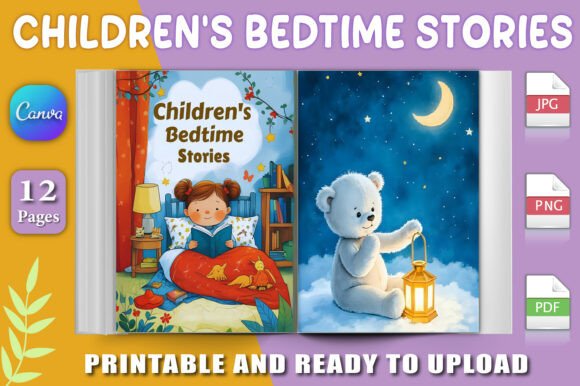
Children’s Bedtime Stories
Imagine tucking your child in, the room softly lit, and watching their breathing slow as you read aloud—not from a screen, but from a gently paced, intentionally crafted story that doesn’t rush, excite, or overstimulate. That’s what Children’s Bedtime Stories delivers: ten original, KDP-ready tales built around rhythm, reassurance, and quiet wonder—not plot twists or cliffhangers, but emotional landing pads for little minds winding down.
This isn’t just another storybook. It’s a practical tool—designed with intention for real-life moments where calm matters more than content. Parents use it nightly to replace scrolling or screen time with shared voice, eye contact, and predictable comfort. Teachers print individual stories for quiet reading corners during wind-down periods. Therapists fold lines from “The Gentle Owl” into social-emotional lessons about listening and patience. And indie authors building KDP catalogs treat it as a proven, editable foundation—swap names, tweak settings, add illustrations—and publish within days.
When and Where It Fits Naturally
Children’s Bedtime Stories works best when timing, tone, and trust align. That means it shines in low-stakes, high-impact moments: the 20 minutes before lights-out, the quiet corner of a preschool classroom after lunch, the hospital bedside where routines feel fractured, or the travel bag for grandparents visiting across time zones.
Take Maya, a speech-language pathologist working with preschoolers who struggle with transitions. She reads “The Sleepy River” aloud twice a week—first slowly, emphasizing soft consonants and long vowel sounds (“rrrrr-iver… ssssslow… fllllow…”), then invites kids to trace the river’s path on laminated story cards. The repetition builds phonemic awareness; the imagery lowers anxiety. No lesson plan needed—just presence and pacing.
Or consider James, a freelance illustrator launching his first children’s book series. He licensed the text from Children’s Bedtime Stories, kept the core structure of “The Little Firefly,” and reimagined the character as a bioluminescent jellyfish in a deep-sea setting. Because the original language was already soothing, rhythmic, and age-appropriate (ages 3–8), he spent less time editing and more time refining visuals—getting his first Amazon ranking in under three weeks.
Who Benefits—and How It Shows Up in Practice
Parents & caregivers: You’re not just reading—you’re co-regulating. When your toddler clings after daycare drop-off, “Benny the Brave Teddy” gives you a shared language for safety (“He holds dreams *just like I hold you*”). When your 6-year-old wakes anxious at 2 a.m., flipping to “The Guardian Star” isn’t about distraction—it’s about anchoring: “She watches over dreamers—no matter where they are.” That line lands differently when whispered in the dark.
Educators & childcare providers: You know naptime resistance isn’t defiance—it’s nervous system overload. Playing an audio version of “The Blanket of Stars” (recorded with ambient night sounds) while dimming lights helps signal shift—not with commands, but with sensory consistency. One Montessori guide told us she laminated the cloud journey from “Lila and the Magic Cloud” into a sequencing activity—kids arrange illustrated cards while whispering each step. Calm becomes collaborative, not commanded.
Self-publishers & small presses: This collection is pre-vetted for developmental appropriateness, inclusive tone, and bedtime-specific cadence. No need to guess whether “The Star Who Got Lost” resolves with gentle reunion (it does) or whether “The Dreamy Cat” avoids scary shadows (it does). You get clean, editable .docx files—no watermarks, no usage limits—so you can adapt for bilingual editions, add sign-language glossaries, or pair with AR animations later.
What to Consider Before Using or Adapting
Not every bedtime story works for every child—and that’s okay. Children’s Bedtime Stories assumes a baseline of verbal understanding and attention span typical for ages 3–8. If your reader is nonverbal, neurodivergent, or significantly delayed, consider pairing it with tactile props (a soft teddy for Benny’s story, a star-shaped pillow for “The Guardian Star”) or shortening passages to one sentence per page.
Also notice pacing: these stories avoid abrupt shifts, loud verbs (“CRASH!”), or complex cause-effect chains. That’s intentional—but if your audience thrives on gentle humor or light suspense, you might layer in subtle sound effects (“shhhhh… puff… twinkle…”) or pause deliberately before key lines to build quiet anticipation.
And while the themes—kindness, bravery, belonging—are universal, cultural context matters. A teacher in Lagos adapted “The Sleepy Moon” to reflect Yoruba lunar folklore; a homeschooler in Portland added Pacific Northwest animals to “Lila and the Magic Cloud.” The text invites respectful localization—not because it’s incomplete, but because its strength lies in being a starting point, not a final answer.
More Than Just Words on a Page
What makes Children’s Bedtime Stories stick isn’t its charm (though it has plenty)—it’s how reliably it serves a human need: helping children feel safe enough to let go. In a world full of flashing notifications and packed schedules, that kind of quiet utility is rare. It doesn’t try to teach multiplication or name continents. It teaches breath. It teaches stillness. It teaches that being small, tired, and loved is enough.
That’s why pediatric nurses keep printed copies in their supply carts. Why foster parents include it in welcome bags. Why indie podcasters narrate single stories as free sleep aids—then link to the full collection for listeners who want physical copies. It meets people where they are: exhausted, hopeful, holding space for something tender.
If you’re choosing a bedtime resource—not for novelty, but for consistency—if you need something that supports regulation instead of stimulation, connection instead of consumption, then Children’s Bedtime Stories earns its place on the shelf, in the lesson plan, or in the cart. Not because it’s perfect—but because it’s purpose-built, tested in real rooms with real children, and quietly, deeply kind.