All Purpose Weekly Planner
Think about your last Monday morning. Maybe you opened three browser tabs, checked Slack, replied to two urgent emails, and still hadn’t written down what you actually needed to finish before lunch. Or maybe you’re a teacher prepping lesson plans while juggling parent meetings and grading—only to realize Wednesday afternoon that you forgot to schedule time for curriculum updates. Or perhaps you’re a freelance designer who just accepted a new client project, but your calendar is full of vague “work on logo” notes with no deadlines, no buffer time, and no clarity on what “done” even looks like.
This is where the All Purpose Weekly Planner steps in—not as another app to learn or subscription to manage, but as a quiet, reliable tool you can open every Sunday evening and actually use. It’s designed for people who need structure without rigidity, flexibility without chaos, and simplicity without sacrifice.
Real Use, Not Just Theory
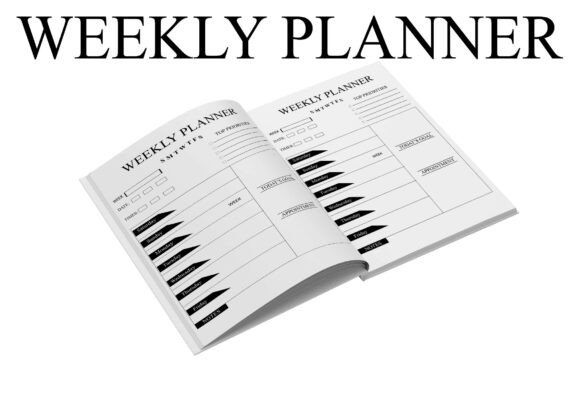
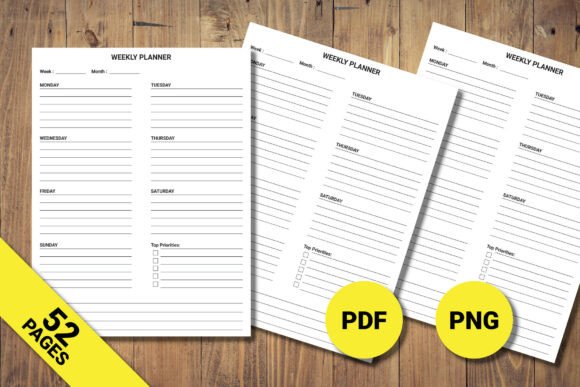
The All Purpose Weekly Planner isn’t built for one kind of person or one kind of week. It’s built for the reality of overlapping roles: the small business owner who’s also a parent, the grad student who tutors part-time and runs a side blog, the marketing manager who leads a team *and* manages their own content calendar. Its 8.5 x 11 inch size fits neatly in a standard binder or on a desk beside your laptop—no scrolling, no syncing, no battery anxiety.
Let’s say you’re launching a podcast. You’ll use the Week/Month Header to write “Podcast Launch Week — May 13–19” at the top—not just to name it, but to anchor your focus. Then, each day’s lined section becomes actionable: Monday = record intro/outro, Tuesday = edit Episode 1, Wednesday = draft show notes + schedule social posts, Thursday = send to beta listeners, Friday = review feedback + prep Episode 2. No guesswork. No “I’ll do it later.” Just space to map it out—clearly, linearly, and in your own handwriting.
Why the Top Priorities Section Changes How You Work
You don’t need ten priorities. You need three. That’s why the Top Priorities Section is a checklist—not a list—and why it sits right at the top of each weekly spread. It forces intentionality. A high school science teacher might write: “1. Grade lab reports (due Friday), 2. Finalize field trip permission forms, 3. Prep demo for Friday’s chemistry lesson.” Nothing else goes there. If something urgent comes up midweek, she doesn’t scrap the plan—she evaluates whether it truly displaces one of those three. That small shift builds decision muscle and reduces reactive overwhelm.
For a solopreneur running a handmade ceramics shop, those top priorities might be: “1. Ship orders placed before Tuesday, 2. Photograph 3 new mug designs, 3. Draft Instagram caption for weekend sale.” Notice how each is specific, time-bound, and tied to a real outcome—not “work on website” or “do marketing.” The planner doesn’t do the work for you, but it quietly trains you to phrase goals in ways that make action obvious.
Daily Space That Actually Fits Your Life
Monday through Sunday aren’t just labels—they’re containers. Each has lined space, not rigid time slots. That matters. A nurse working rotating shifts doesn’t need hourly blocks; she needs room to jot down “Prep med cart for 7 a.m. handoff,” “Call pharmacy re: patient X’s refill,” and “Follow up with unit manager re: staffing gap.” A writer drafting a novel might use the same space for “Write 1,200 words (Ch. 7),” “Email editor re: feedback timeline,” and “Research 1920s train schedules for scene accuracy.” The lines hold enough—but not too much—so nothing feels overwhelming or underutilized.
Notes Section: Where Ideas Stop Getting Lost
We’ve all had that moment: an idea hits while brushing teeth, you whisper it into your phone, and by breakfast, it’s buried under five voice memos and three unread texts. The Notes Section at the bottom of each weekly spread is your low-friction capture zone. No formatting. No app permissions. Just blank space—lined, yes, but generous—where you can sketch a product idea, list grocery items, draft a text to a client, or note “Ask Alex about SEO audit timing.” Because ideas are only useful if they survive long enough to become action—and this section helps them stick.
What to Consider Before You Print (or Download)
The All Purpose Weekly Planner is print-ready at 300 DPI—crisp, professional, and optimized for home printers or local print shops. But before you hit print, ask yourself: How do I actually plan? If you consistently forget to look at your planner until Wednesday, consider keeping it open on your desk—not filed away. If you prefer digital tools but miss tactile planning, try printing just one week at a time and using it alongside your calendar app (e.g., block “planning time” in Google Calendar every Sunday at 6 p.m.).
The transparent PNG and PDF formats mean you can layer it over a favorite notebook page, add it to a Notion template, or import it into GoodNotes for stylus writing. But here’s the practical truth: its power multiplies when you treat it like a ritual—not a resource. Five minutes every Sunday, pen in hand, reviewing last week’s priorities and filling in next week’s header and top three items? That’s where consistency builds momentum.
Who Benefits Most—and Why
- Freelancers and creatives get clarity on project phases—not just deadlines, but the small steps between “idea” and “delivered.”
- Educators use the daily sections to align lesson prep, grading, and communication—without letting any one area bleed into the others.
- Small business owners keep operations, marketing, and admin visible in one glance—no more toggling between spreadsheets, apps, and sticky notes.
- Students break large assignments into weekly actions (“Draft thesis outline,” “Book library study room,” “Email professor re: sources”) instead of staring at a syllabus and feeling stuck.
- Hobbyists and lifelong learners track progress on skills—like practicing guitar for 20 minutes daily or reading 30 pages of a language textbook—because consistency shows up clearly on paper.
It works because it doesn’t assume your schedule is fixed, your goals are static, or your week will go as planned. It assumes you’re human—and gives you space to adapt, reflect, and move forward without starting from zero every Monday.
The All Purpose Weekly Planner won’t magically add hours to your day. But it does help you protect the ones you have—by making priorities visible, reducing mental clutter, and turning intention into ink on paper. And sometimes, that’s the most productive thing you can do.